Skip to Content

Posts tagged with Continuous improvement

Describing highly variable processes with Work Unit Routing Analysis (WURA)

Closeup of a beach in Saw, Washington covered in these little tiny snails.
Photo by Brian Kerr.

A method for documenting & understanding processes when people say there isn’t a process.

WURA WTF

An easy way to understand Work Unit Routing Analysis (WURA) is to start with its predecessor, Product-Quantity-Routing (PQR) analysis.

You’ll find PQR analysis used in settings where there are a lot of small-batch custom orders. Take a print shop, paint shop, or light manufacturer that has to set up and configure workspaces and equipment for a specific run of work, ship those off, and then re-set and re-configure things for the next, different, run. This is an environment where some things are always different, and other things are always the same. Knowing which materials—supplies, stable intermediate forms, scrap/junk, and final products (P)—are being produced and in what quantities (Q) as they’re routed (R) across the shop becomes the basis for various insights.

WURA was the extension of this analytical approach to clinical settings, and from there into other types of work—including the hopelessly computer-addled work I get involved in. To call the products of labor ‘work units’ (WU) upon which one could perform a similar routing analysis (RA) is a meandering walk but it eventually gets us to the WURA acronym.

My experience has been that some people have heard of PQR and others WURA. The happiest people have heard of neither.

When you might use WURA

WURA is a great fit for low-volume, moderate complexity, highly variable work. When I hear something like “we don’t have a process” or “every <instance> is different” I consider whether WURA might be an appropriate format to use.

I’ve personally used WURA:

  • To document various ways projects got approved inside a corporation while bypassing the official, mandatory approvals mechanism.
  • To discern how a real estate company prepares distressed properties for sale at auction across various geographies, property conditions, and the like.
  • To understand billing procedures for a professional services firm across its various lines of business and combinations of customers, industries, and project types.

How to run WURA

Note: click or tap an image to see it full-width.

Describe a single scenario

First, document a single scenario in a single row in a data table. In this example, there are six major process steps, numbered 1-6 and each given a short but descriptive name.

The easiest way to get this down is to follow a single ‘work unit’ around and see what people do. This initial scenario doesn’t have to be a typical or even common case; it’s merely the first one you’re writing down. Don’t worry about exceptions handling or alternate scenarios yet. These will get their own rows later.

Any methods you’ve used elsewhere for identifying and distinguishing process steps will work here. (For example: look for transitions, hand-offs, or notifications.)
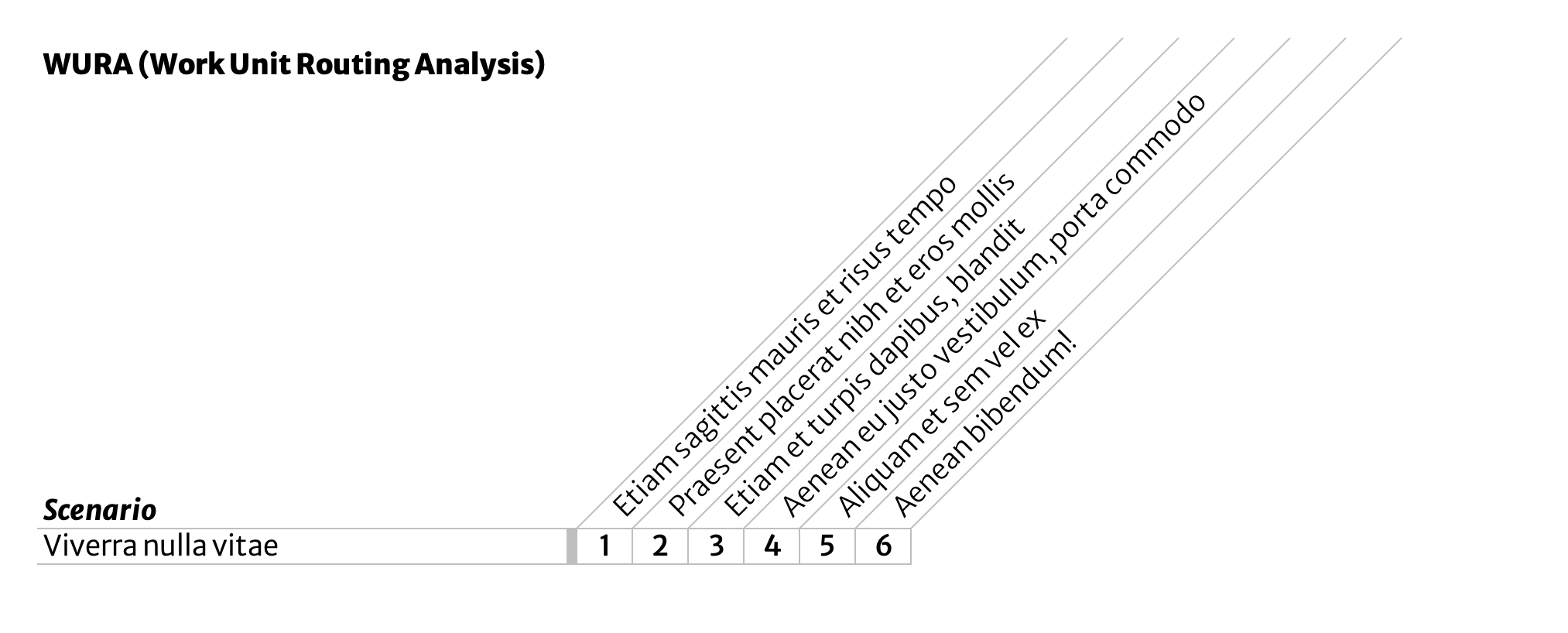
A single scenario is documented. It has six process steps.

Document additional scenarios

Next, document as many additional scenarios as you encounter, using the same format. Number process steps in sequence. Add new process steps as you see them. This list is totally unordered at this point. Keep adding exhaustively.

Exceptions, special cases, rush jobs, undisussables—each get their own row.

Seek to keep process steps at approximately the same level of detail. Split, combine, and rearrange in order to match what is actually happening.
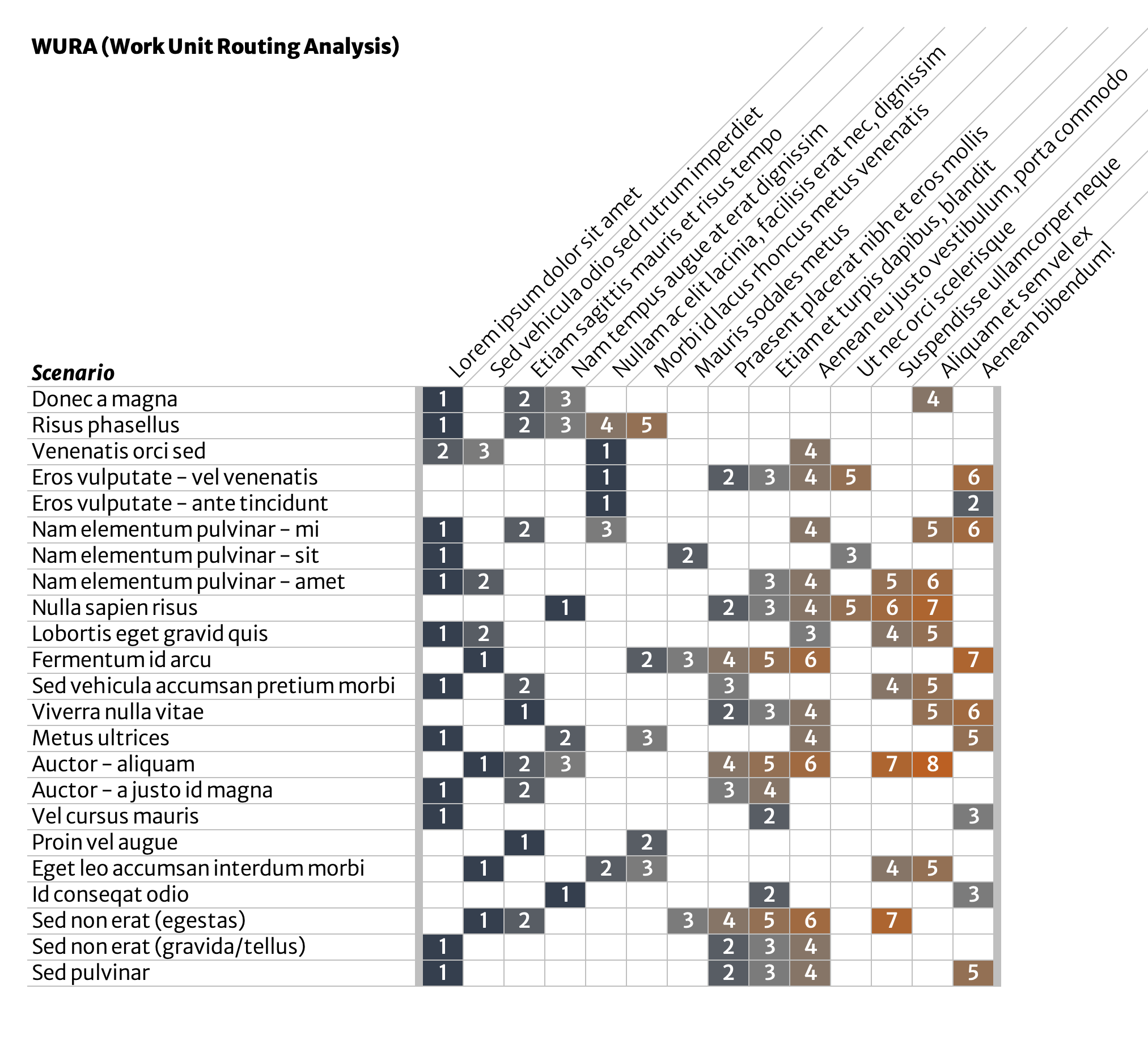
Various scenarios are documented. The initial scenario is now about halfway down the list.

Annotate with frequency & quality data

At some point you will exhaust scenarios people can show you or that you can observe. Someone might say that “every <instance> is different” but the finite length of this scenarios list indicates otherwise—at least when viewed from a this level of abstraction.

Once you’ve gotten here, annotate the list with a few data points for each scenario. What’s important to measure? Use your best judgement, tempered by availability of data. Two good starting points are those shown in our example:

  1. Frequency: # of ‘work units’ produced via this scenario over a certain time (a month, a quarter, a year).
  2. %C/A: percent complete & accurate; this is a percentage of work items that are both complete (nothing missing or broken) and accurate (correct) as they exit each scenario.
    • Not shown here, but much more powerful, is to also measure %C/A for each process step. In this case, you’d want to measure how often work items enter the given process step without quality issues.
    • This can also be a good moment for a conversation about accuracy and how it is or should be determined.
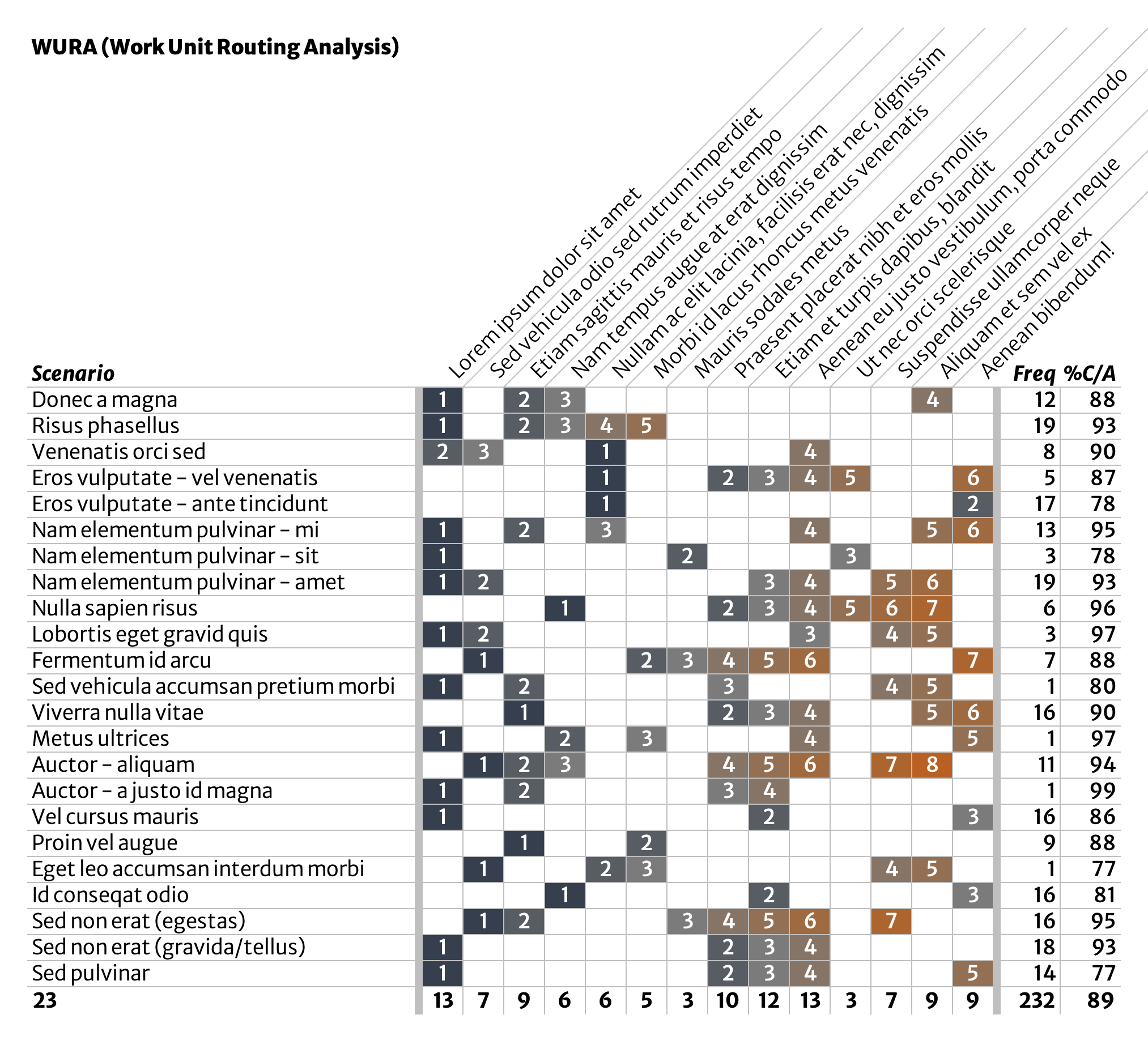
Frequency & quality data for scenarios (right columns); scenarios count for process steps (bottom row).

Initial analysis—what do scenarios have in common?

Sort and slice. In this example, about half of the scenarios, and a majority of the overall volume, begin with the same process step (‘Lorem ipsum dolor sit amet’, seen in the second column of the table). Ask yourself what these have in common.

What about scenarios that start with some other process step? Extend this initial analysis to also include the ‘Sed vehicula audio sed rutrum imperdiet’ process step and you’ve identified where most work starts, even though “we don’t have a process.”
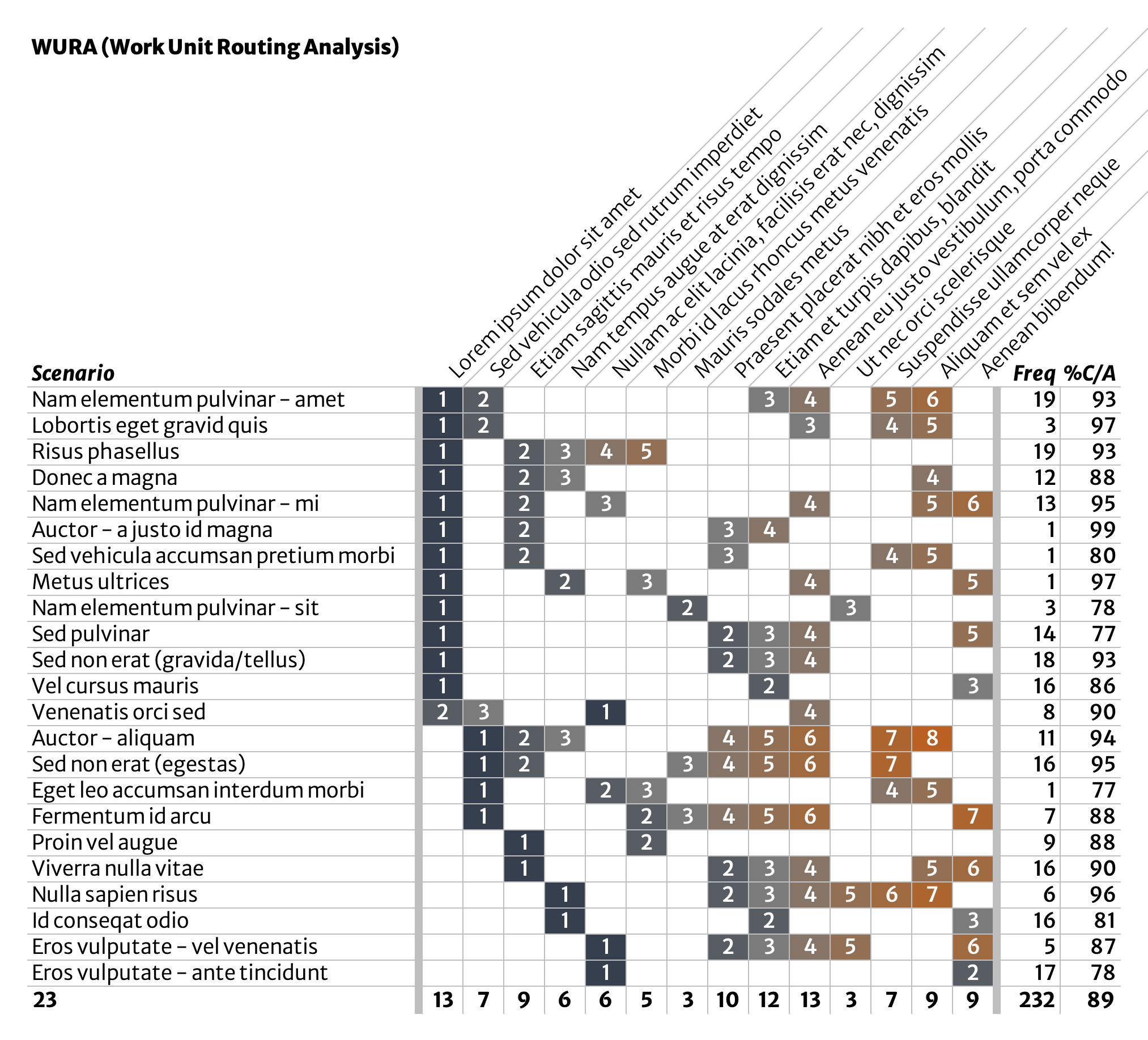
Scenarios arranged by process steps.

You might also notice a little set of three process steps, highlighted below, that are a feature of several scenarios. What might these have in common? What’s the case for scenarios relying on one or two, but not all three, of these process steps?

Lines of questioning like this can help you notice possibilities for simplifying or standardizing work in beneficial ways.
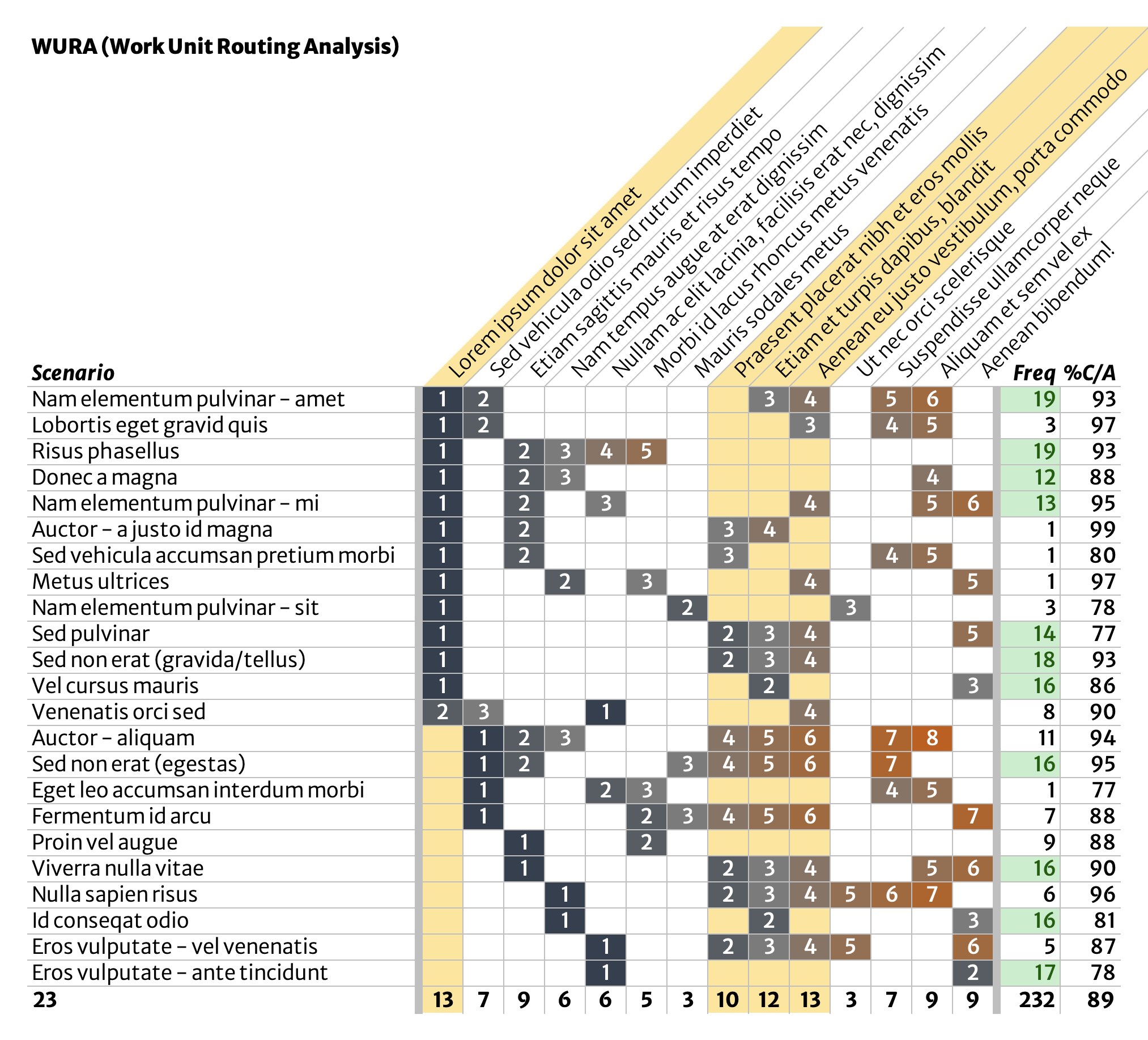
Highlighting the initial process step for most scenario and an interesting cluster of three.

Initial analysis—clean up outliers

Another very quick analysis is to look for the true outliers. The highlighted process steps below appear only in a handful of scenarios, and only one of those scenarios (‘Sed non erat gravida/tellus’) arises at a decent frequency. These process steps might be eliminated entirely, possibly even by adjusting or removing the scenarios they are a part of.

Anything that can be removed entirely is a treasure.
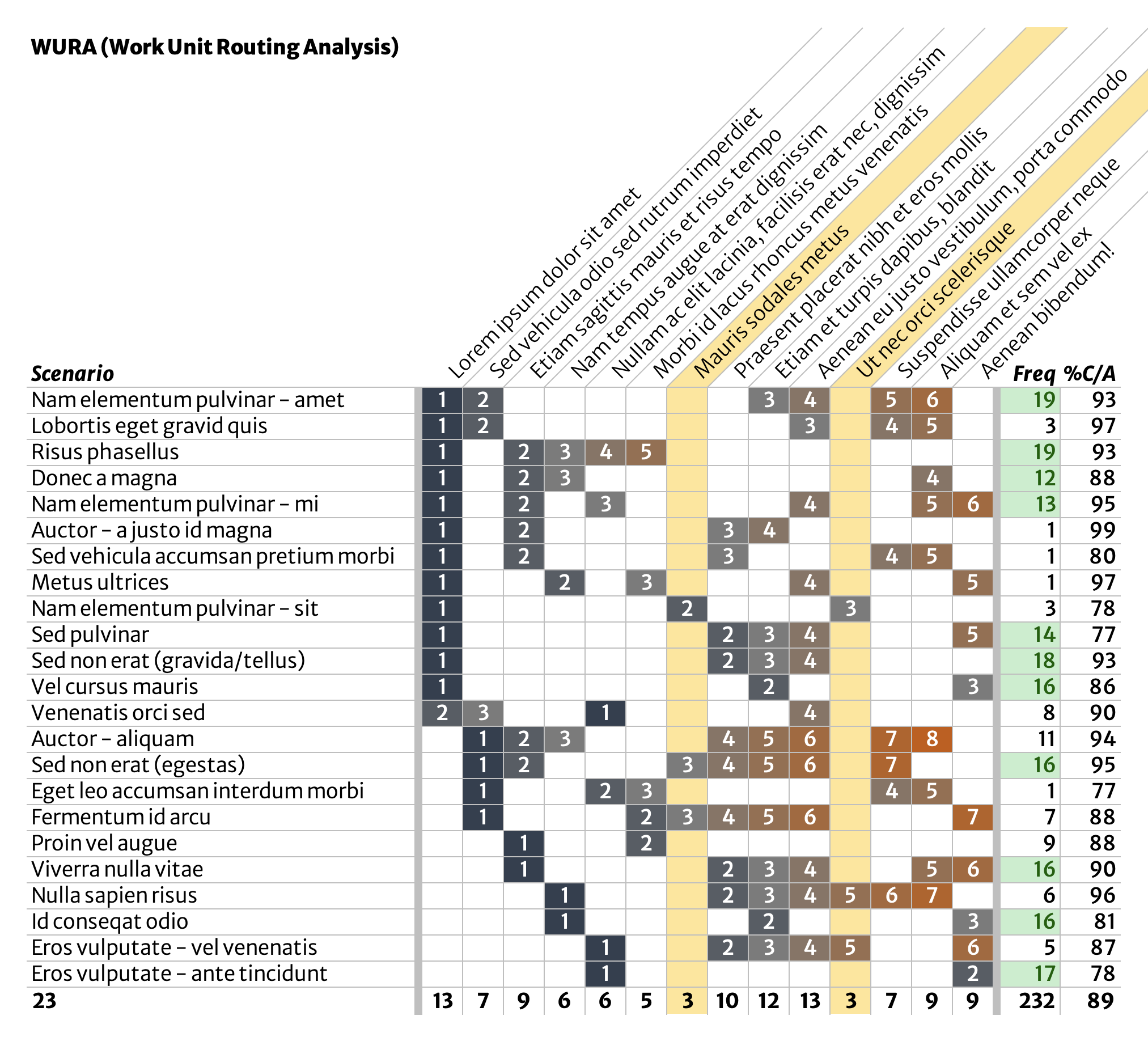
Highlighting the bigger ticket scenarios.

Possibilities for further analysis

  • Determine which process steps contribute most to overall volume. This is an area where WURA can get you in trouble, because the most visually busy process steps might not be the ones you’re looking for.
  • Isolate process steps where errors are produced and build in quality along the way.
  • Measure worker sentiment/happiness with each scenario.
  • Group scenarios into scenario families based on their similarities. Organize continuous improvement at this scenario family level if working on individual scenarios one at a time doesn’t seem like it’s enough.

Vanishing fish, boiling frogs & the dry bed of the sea

Another sunset behind the mountains, obscured by some patchy clouds, and reflected in a cool blue body of water.
Photo by Brian Kerr.

Making sense of ‘shifting baseline syndrome’ in the world & in the workplace.

audio-thumbnail
Podcast episode 0033: Vanishing fish, boiling frogs & the dry bed of the sea
0:00
/596.832

More podcast episodes online or in your favorite app.

The original tagline for this site and newsletter was ‘continuous improvement in a world that’s one damn thing after another.’ Today let’s revisit that last bit. What does it mean for a world to be one damn thing after another? And what does this have to do with the potential for continuous improvement, or the possibility of provision?

Something fishy

In 1995 fisheries scientist Daniel Pauly (by this time 20 years into his career and already a prolific author) wrote a one-pager published on the back page of an obscure biology journal.

This was the location of one of the biggest, gloomiest ideas going. Pauly described a ‘shifting baseline syndrome’ affecting his profession:

This syndrome has arisen because each generation of fisheries scientists accepts as a baseline the stock size and species composition that occurred at the beginning of their careers, and uses this to evaluate changes. When the next generation starts its career, the stocks have further declined, but it is the stocks at that time that serve as a new baseline. The result obviously is a gradual shift of the baseline, a gradual accommodation of the creeping disappearance of resource species, and inappropriate reference points for evaluating economic losses resulting from overfishing, or for identifying targets for rehabilitation measures.
📖
Read this article for yourself. It’s very short: Anecdotes and the shifting baseline syndrome of fisheries.

Pauly viewed this as a generational ‘shift’ to be countered with careful data collection and analysis. These countermeasures would occupy much of his time and publication schedule for the rest of his career.

The blissfully boiling frog

When I first read this article some years ago, it really stuck with me. It seemed to explain a lot. But I wondered:

  • Might it explain more, and more broadly? Doesn’t everybody do this?
  • And at a faster pace than the gradual, generational cycles under discussion? I believed then, and believe now, that people can get used to just about anything. The evidence is all around us.
  • I also worried that expanding the idea of ‘shifting baselines’ beyond Pauly’s original scope would lead to nostalgia. There are many important ways in which the present is better than the past, even as we rush to forget what has passed away.

Eventually I poked around the archive. No surprise that Pauly continued to think and write about this big, gloomy idea.

In 2011—sixteen years after ‘shifting baselines’—he wrote:

Without firm rooting in scientific, quantified knowledge of what we now have, or had, we will inevitably experience the ‘shifting baseline syndrome.’ As I have described, successive generations of naturalists, ecologists, or even Nature lovers use the state of the environment at the beginning of their conscious interactions with it as the reference point, which then shifts as successive generations degrade that same environment. The story of the frog kept in water that is heated very slowly comes to mind here, and if we are not careful, we are going to get boiled as the frog does: a runaway greenhouse effect would do the job nicely.

I found here in the 2011 writing the broadened scope, the boiling frog, and the slow-but-fast progression of human-caused climate change that is the defining feature of our century.

The decade-scale example is excess deaths caused by COVID-19. We never did a great job tracking mortality due to COVID. Instead, we mostly stopped counting 3 years ago, and mostly stopped estimating one year ago, as the body count neared 30 million. There is a huge impulse to forget and to move along, although insurance companies remember. (Thanks to Susannah for these links.) Is this another aspect of shifting baselines? Despite, alongside, and during this unsurpassed tragedy, we continue to care for the people in our lives and provide and labor in community. What the hell else would we do? Emerson wrote that “we learn geology the morning after the earthquake.” This is true; also true is that only a few days or years pass before the “cloven mountains, upheaved plains, and the dry bed of the sea” become as unremarkable as any other feature of our surroundings. A disaster as invisible as any other.

Pauly made an additional point—also revealed to me by my friend Summer:

For baselines to shift is not always bad. There are many stupid things that must be forgotten even if they have been the rule for thousands of years. Getting rid of these notions will free our minds and enable us to concentrate on things that matter, including some important things that we should remember.

Forgetting, remembering—and in Pauly’s discussion, forgetting some things in order to remember others. All baselines can shift. It seems that most will. But a few must not, lest we lose our footing during the ongoing scramble toward liberation. This is the idea. It is big, and it is gloomy.

📖
These 2011 quotes are from a book chapter called “On baselines that need shifting.” It is reprinted in Pauly’s 2019 book Vanishing Fish.

Shifting baselines in the workplace

This is not mere theory. I see it in my daily efforts as a consultant supporting people in their work and in their workplaces.

  1. The conditions of shifting baseline syndrome—of vast, continual retrenchment of natural and built and social environments—are those under which people work. Even if undiscussable, it’s ever-present.
  2. As someone who lives and works in the US, this has only accelerated in our current bad times. The Christian fascists in power have an agenda that depends on baselines shifting quickly and broadly. Whether people resist and ignore this—or, as a minority do, accept it—the effort keeps everyone distracted and uncomfortable.
  3. Finally, certain ultra-Amazonified workplaces intentionally leverage the ‘shifting baseline syndrome’ to get staff to accept bad policy, missing strategy, poorly leveled workloads, and so forth.
    1. If employees are to perform inside these settings, they must develop a context-free, history-less pragmatism.
    2. Some people will shift to accommodate.
    3. Other people will wash out.
    4. Either way, the corporation gets what it wants.

I don’t have answers to any of this. But I find it helpful to remember that these are the conditions people are in.

Pauly’s closing advice

Let’s give Pauly the last word. He ended his 2019 book Vanishing Fish with an offer of advice, which—after all of the above—I was eager to accept. His advice is honest and true. I suppose time will tell whether it is sufficient. Pauly wrote:

If I have any advice to give, it is that one should have friends and work hard.

Why people work at cross-purposes & what to do about it

Why people work at cross-purposes & what to do about it
Photo by Brian Kerr.

A guide to finding & making the most of disagreements.

When you’re learning your way through a new organization, look for peers or collaborators working at cross-purposes—people who are working together, but towards different ends.

For example:

  • A will tell you the purpose of her work is to solve a social problem.
  • B will tell you the purpose of his work is to make sure resources are shared fairly.

Another example:

  • C wants to make something customers have never seen before—but that they’ll love the moment they see it.
  • D needs people to pay a little bit more, or costs to come down, or both.

Why this happens

People work at cross-purposes when they value different things:

  • A & B don’t agree on the purpose of their work. They disagree on underlying principles, not in the particulars.
  • C & D are trying to produce different results with their work. Each has a perspective that is necessary for the organization, but you can imagine how they’d clash.

Three responses

These conflicts—propped up by different individual understandings of goodness—store a lot of potential energy. What does one do with all that?

Three responses I consider:

  1. The dismal response. Working at cross-purposes makes people unhappy; it generates needless suffering, worry, and conflict. Decreasing any of that opportunistically is important.
  2. The pragmatic response. As a consultant, I look for the hand-offs. That’s where things break, where errors get produced and passed along. When people are working at cross-purposes, their hand-offs tend to be bad. Fixing these is one of the first, and best, local improvements I can make.
  3. The optimistic response. Maybe there is a chance to gather everyone together and figure out what “good” means.

What good means—and who decides

I used to believe the received wisdom from lean, as mired in bog-standard management—that it is the task of leadership to define what’s good and then to require everyone else adhere to that standard. From this comes various goofs, gags and sacraments: True Norths, Mission Statements, Visions & Values. Things most people in an organization don’t remember, don’t care about, and can’t relate to their own work.

Barring that, there are elaborate structures organizations can construct and service over time to give an answer to what good means and show how everything connects. This is the realm of OKRs, KPIs, PuMP, and so forth. These can be useful, but take effort to keep active. They are leaky buckets.

These days, I think it’s best that everyone decides what good means, together. You gotta sit down and do it.

Many executives, and many organizations, don’t have the appetite for that.

I can’t close this section without a link to Dan’s essay on the topic. And yes, Dan is the person I swiped the “what good means” question from:

What Good Means
I’m obsessed with the question of what “good” means, and blame the genius loci of West Michigan for this affliction.

Three questions

The rubric I use to help a group get through it is three simple questions, asked and answered one a time, with as much care as needed:

  1. What do we make?
  2. Who do we make it for?
  3. How do we know if it's any good?

As you work through these, draw a diagram or write a few sentences. Disagreements will arise. Sometimes they touch on various forbidden or undiscussable topics. But in the end you’ll find something the group created together that sets the standard for what good means, here, today.

8 ways to push a problem around (without fixing it)

8 ways to push a problem around (without fixing it)
System: The Magazine of Business, January 1914. Published by the A. W. Shaw Company, Chicago. Thanks, Scan City.

A “to not do” list.

  1. Do the very first thing someone suggests. Commit as many resources to it as possible: we’re all in on the new approach, no matter what.
  2. Do the very first thing someone suggests. Do not commit anything at all to the solution: we’re doing more with less.
  3. Don’t waste valuable time identifying or understanding the problem. As people wheel and mill around and solve for slightly different things, it’ll boost creativity or some damned thing.
  4. Fix something upstream without looking downstream.
  5. Fix something downstream without looking upstream.
  6. Have you considered a reorg?
  7. Don’t talk to customers. Of course you know who they are and what they want. This goes without saying.
  8. Whatever else you do, put a thing on the timeline called “evaluate & adjust” or similar. Schedule it to be held in 6 months’ time. By then, everyone will have forgotten.

Dan’s Device: “Now that I see it… [it’s completely wrong.]”

Dan’s Device: “Now that I see it… [it’s completely wrong.]”
Photo by Brian Kerr.

After “now that I see it” come words you need to hear as early as possible.

It is 1976. Neil Diamond saunters onstage at The Last Waltz and introduces his performance of ‘Dry Your Eyes’ by saying:

I’m going to do one song for you, but I’m going to do it good.

Isn’t that what we all want? We want to do something once, and to do it good. And easy enough: the first step is to be Neil Diamond.

The rest of us should probably acknowledge that—whatever the work is—we’ll have to do it more than once, because it almost certainly won’t be done good the first time.

My friend Dan gave me the notion of the now-that-I-see-it moment. This occurs when a work-in-progress becomes real enough that people can say a sentence beginning with “Now that I see it” and ending with things like “it’s completely wrong” or “we forgot this important detail” or “this will never work for this particular reason.

Methods for building quality at the source, shifting left, set-based design, and so forth all help elicit “now that I see it” moments as early as possible.

By arriving earlier to “now that I see it,” we also arrive earlier to the wrong place, to the just-revealed insight, or to the key constraint. It is hopefully early enough that there is wiggle room to learn and iterate and retry.

Airbrushing the side of a van is delightful. It is a job that takes as much time as you care to give. But you need only outline those first few flames and/or wolves to wedge open space for the objection that what we really need is a bicycle, or for the idea that we might be able to take the train.

I leave you with this dismal little project management couplet:

“Now that I see it” is certainly true;
That’s why to use tape first & then glue.

(This advice does not apply to Neil Diamond or to his beaded shirts.)

Noticing little things & little thinks

One of my favorite logs in the world. It is out in the tide, where its mere presence is enough to stabilize some gentle wav
Photo by Brian Kerr.

Noticing at work. Noticing on the cushion. And noticing while out & about. These three are related. I am still figuring out how.

I’ve written about the power of noticing before:

Beyond all this, I spend a certain amount of time and effort on a meditation cushion, where mental noting has been a tremendous relief and balm over the years. Briefly, mental noting is a practice of noticing and ‘tagging’— without discussion or judgement—sensations and thoughts as they arise.

Capability and joy come through seeing things with a little less presumption, a little less judgement, and a little less hurry towards sense-making.

Noticing while out and about

A great way to try different ways of seeing and experiencing is to play some of the games in Rob Walker’s The Art of Noticing. One example is the “secret scavenger hunt” of looking for security cameras while running an errand: which cameras want to be seen?—and which want to remain hidden?

The ant’s puzzle

How is observing the bottoms of coffee mugs (a Rob Walker staple) similar to looking carefully for those places where workplace environments produce errors, injury, and waste?

And what do both of these have in common with the experience of sitting quietly for a moment and paying careful attention to the quantity of thoughts that arise unbidden and just as quickly fall away?

I don’t have a tidy answer. I wish I did.

I can see that these three are related somehow, meaningfully. It is as if they were three legs of a stool that I—as an ant—endlessly crawl to and fro and back to, without apprehending the larger structure. I will keep trying, and I encourage you to give it a go as well.

August 30, 2024: Edited for length.