Checking in with Comfort-Stretch-Panic
When something big is going on—when bad news arrives, as they say, on horseback—it can useful to check in. One of my favorite ways to do this can be accomplished in only a few minutes, either with a group or by yourself. Here it is.
First, take a look at this diagram:
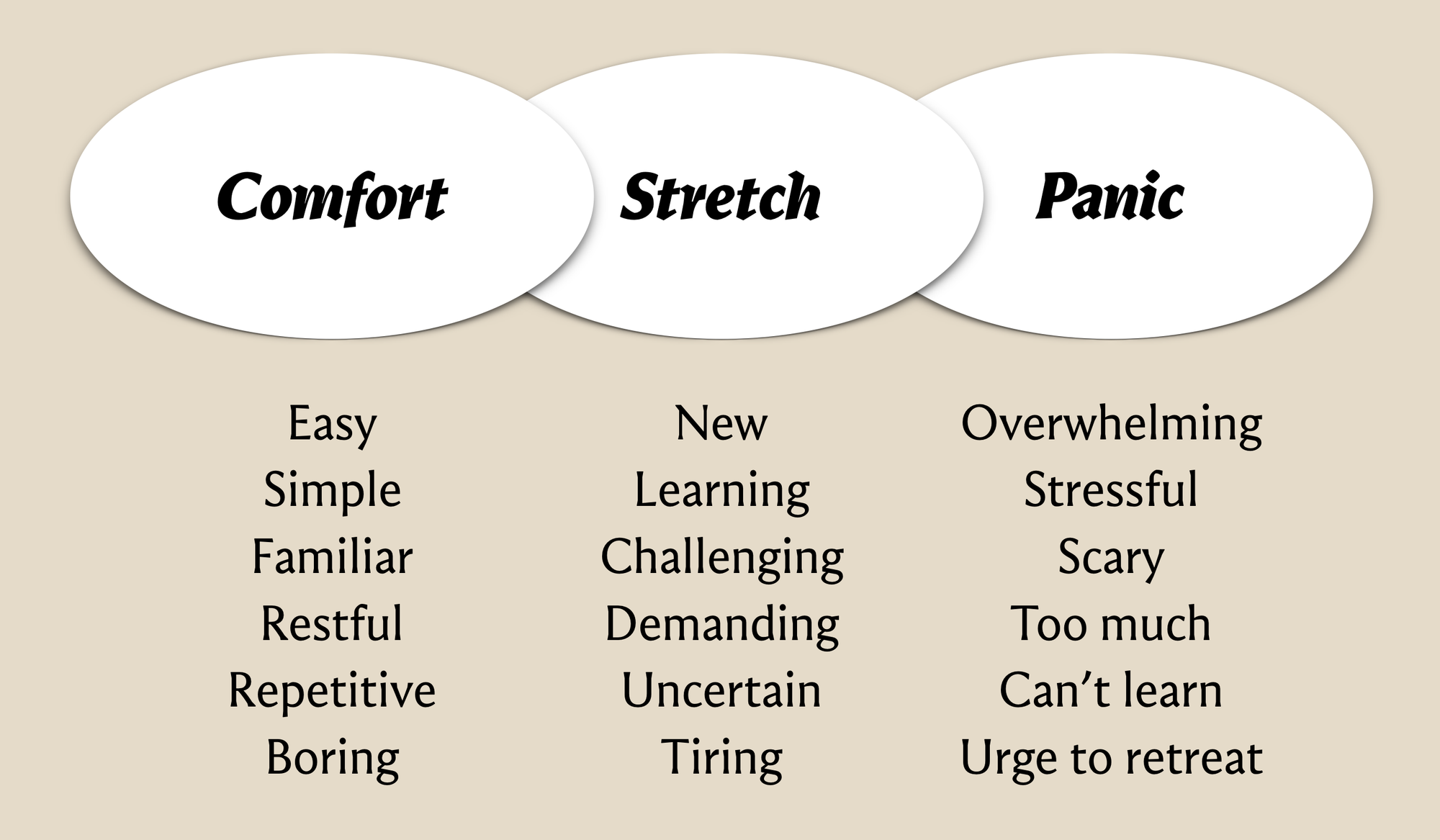
Then, consider the question:
Where are you right now?
Really, pause for a moment. Point to the screen. Find your spot. Then take a deep breath.
- You might think Comfort is the ideal place, but in fact it’s not, at least for long. We can and should rest in comfort, but not abide there. The familiar becomes repetitive, then eventually monotonous and boring.
- On the other end, Panic seems like a bad deal, and it is.
- In general, a good spot to be is with one foot in Comfort and the other in Stretch. Shift back and forth as needed. In other words, Stretch, but when it’s too much, hopefully you can lean back into Comfort rather than tip forward into Panic.
In any group of people, individuals will find themselves in different places on the diagram at different times. It’s more of a herd than a formation. This is OK.
When facilitating a meeting or other group session, you might practice guessing where individual people are on the diagram. That can influence whether you need to slow down, mix things up, take a break, or intervene in some other way. Better than guessing: ask. Run the check-in.
And when looking at the broader context of an organization or team, you can identify forces or vectors that push people toward one side or the other of the diagram. Contemporary Amazon-style management practice is to push people to the very cusp of Panic and then to keep up the pressure. On the one hand, people can produce a lot of work in that Stretch zone, which is a way to make numbers in the short term. But on the other hand, when the pressure stays on for too long people get tilted all the way into Panic. This is much worse in the long run, both in terms of (a) how people show up and (b) the damage it does to them personally as human beings over time.
Personally, I am emerging from a little period in the Panic zone, which I barely was aware of while in there. It’s like the feeling after a summer storm. A fresh, crisp breeze and air pressure ticking back up. Time to assess the damage and figure out what’s next.
Celebrating Disability Pride Month
July is Disability Pride Month. Two offerings.
First, I revisited this writing from 2023 and I invite you to as well. “They say the body is a city with nine gates. Two of mine happen to be a little finicky.”
 Brian Kerr
And second, Lissy of Play at the Office shares Find Your Words, a computer game you can play with your team.
On the site this month
I’ve been keeping up the podcast, with short episodes releasing weekly. Listen along or follow the show.
And finally, a recent blog post you might have missed:
 Brian Kerr