Skip to Content

Posts tagged with Monthly notes

Wrapping up the first 10 years of Improve Something Today

Waves lapping onto a rocky, somewhat gloomy shore.
Photo by Brian Kerr.

It’s been a busy two weeks on the site :)

Over the past two weeks I’ve been celebrating the first (?) decade of Improve Something Today by putting together 10 posts. I wanted to share them with you as a bit of a wrap-up, and express again my gratitude for your being a part of this, for reading what I have going on, and for replying or getting in touch with your thoughts in various ways.

So: thanks again. And here are 10 things to read, if you like. Have a great time—I know I did!

I started the series with 10 things I’ve learned during this writing:

10 things I’ve learned in 10 years of writing Improve Something Today
This site is about learning in public. As it turns a decade old, I scrounge around for 10 things I’ve learned while writing it. Also: my gratitude.

These next two posts were drafts I’d had sitting around and welcomed the excuse to dust off and share:

Two facilitation methods starting with a single line: Actions|Results & +|Δ
Two simple facilitation methods you can start anytime by drawing a single line on a sheet of paper. What these are and when to use them.
Three ways people respond to a problem (other than solving it)
Noticing responses to problems; there’s a whole set. The consultant’s reaction to each of these as they arise.

This one completes a four-part series I started in 2022:

Open space technology, principle 4: “When it is over, it is over”
Appreciating circles that have been opened but not closed.

Two topics I wanted to write about, but didn’t have as much to say on. Shorter posts work well on this site—I’ll consider more of those in the future:

Five contributions to a project: money, effort, attention, memory & wisdom
Following on Jerry Weinberg’s point that ‘the money is usually the smallest part of the price,’ what other prices are to be paid, and how should a consultant approach these contributions?
Tilopa’s six words of advice
A six-word poem to be appreciated, for today, as a poem.

And wrapping up with some favorite topics from the site, a favorite continuous improvement method, and some favorite books:

Our favorites, so far
Now that Improve Something Today is a decade old, here are some of your favorite—and my favorite—of the things I’ve offered to date.
Describing highly variable processes with Work Unit Routing Analysis (WURA)
A method for documenting & understanding processes when people say there isn’t a process.
A decade in books
Nine books I’m always reading.

Questions along the way

Looking down into a rocky beach at low tide, with a weathered wooden beam in few; a few barnacles and lichen live on this beam.
Photo by Brian Kerr.

The Periodic Table of Questions, ICA’s ORID, Liberating Structures’ W3, and more. How might we organize questions, and to what end?

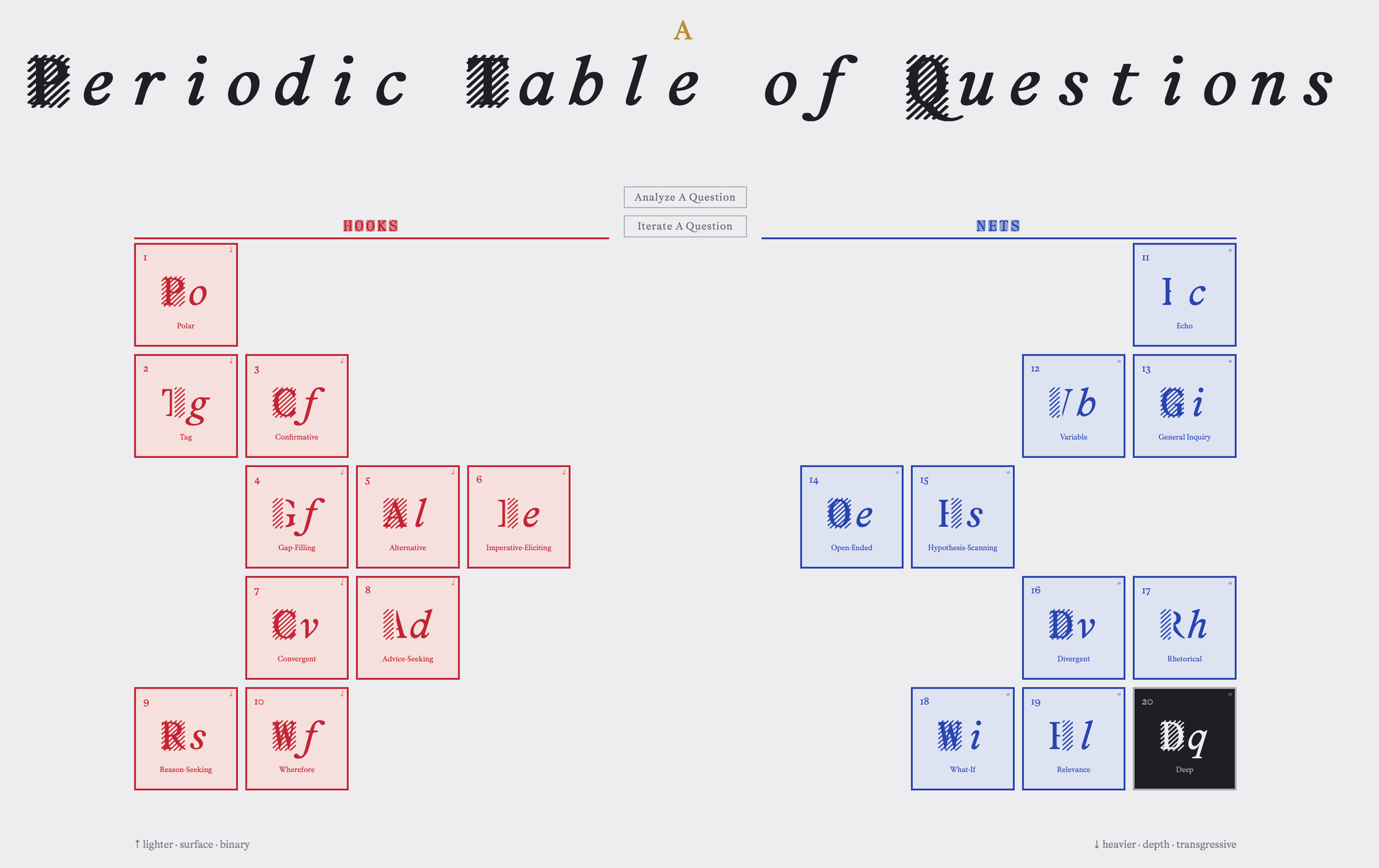
Dan Klyn offers this Periodic Table of Questions. 20 genres of questions, arranged spatially from left to right as hooks (questions with bounded answers) and nets (questions with open answers), and from top to bottom on an index I sense intuitively but still can’t describe as concisely as he does:

Image of a Periodic Table of Questions, available online at https://danklyn.com/questions.html

This is immediately interesting to click around. Click on each for an example question. Dan has a talk and draft book chapter available.

Also, it’s immediately useful. You can provide a question and the thing will guess what kind of question it is. You can ‘iterate’ a question and it’ll give you restated versions of your question across all 20 genres. (Must be some ill-begotten LLM device behind the scenes; re-roll if you don’t like what you see; use the cut-up method to swipe only the results that are meaningful to you. Meaning comes from you, not the randomization device.)

I told Dan it reminded me of ORID from the Institute for Cultural Affairs:

ORID as an Underlying Structure for Effective Meeting Design
We teach ORID as the structure of a Focused Conversation. However, it is much more than that. Since it reflects the natural steps in how human beings process information, it is also useful as an underlying “meta” structural design for a facilitated event. Any appropriate facilitation tools can be used at any of the four […]

This is how ICA teachers advise a facilitator to arrange a ‘focused conversation’—one of several basic extremely valuable facilitation methods they teach. To design a focused conversation, you write up a sequence of questions in deliberate sequence across 4 levels: objective, reflective, interpretive, and (the most unlovely word of all) decisional. The Periodic Table of Questions has helped me arrange questions for one focused conversation so far, and I look forward to more. I do a good job of figuring out what the questions should be, but never want to slow down and get the wording just right. And one feature of the focused conversation is that if you have great questions in the right order, there is very little else to do. A group then brings itself to the appropriate ending point for a meeting or activity.

A simpler version of this approach, one which trades away a lot of nuance for being easier to do, is the ‘What, So What, Now What?’ (W3) liberating structure:

Liberating Structures - 9. What, So What, Now What? W³
liberating structures, social invention.net, microstructures, disruptive innovation, behavior change, collaboration, social invention, diffusion of innovation, strategy, transformation, heuristics, complexity science, emergence

W3 is based in part on the work of Chris Argyris (who I’ve written about before—

‘Undiscussables’ 45 years later: still here, still bad & somehow even worse
Revisiting Argyris’ ‘undiscussables’ as emergent, unwanted behaviors & as features of organizational control. Keeping courage, showing kindness.

—and whose writing and ideas I rely on in my consulting practice). The ladder of inference shared in the W3 method feels like a fast-and-loose alternative to ORID.

Simpler still is to ask a single question, my own shortcut method:

“What did you notice?” → End your meetings with this short, powerful question
The simplest technique I know.

When this works, it is because starting with something at the “data” level (as per the ladder of inference), or the “objective” level (per ICA’s ORID/focused conversation), or the lighter/topmost “net” questions (per the Periodic Table of Questions) is always enough to get a conversation started, and often enough to keep a conversation moving along, of its own accord, to its conclusion.


One last point. Jerry Weinberg had remarkable advice about not inflicting help—by which he meant offering known, or supposed, answers before someone is ready to ask for help. Over the last 20 years, this idea has made all the difference for me. The distinction between being (a) this dreary little (presumed) know-it-all and (b) a helpful colleague. Which is to say: people might not want the answer to the question you wish they would ask, but they might listen to your question if you ask it with kind curiosity, in the right way, and at the right time.

Remembering Christopher Alexander: love even for the smallest pebble

A stone walking path going up a gentle incline with winter foliage surrounding.
Photo by Brian Kerr.

Two passages from the architect and writer on the fourth anniversary of his passing.

audio-thumbnail
Podcast episode 0039: Remembering Christopher Alexander
0:00
/306.21866666666665

More podcast episodes online or in your favorite app.

Christopher Alexander, architect, passed away four years ago today. He was a direct influence on several of my teachers, mentors, and friends, although I knew him mostly as a warm writer of challenging ideas. The independent consulting company I ran for a decade was called ‘Different Chairs’ after a passage he cowrote.

First, let’s enjoy the crispness of Alexander’s writing. Here’s a passage from his first book, Community and Privacy, coauthored with Serge Chermayeff, published 1963:

People want to be everywhere. The reason they moved out was to find the country and escape the disadvantages of the city. The reason they are moving back is that the country is no longer there and they would like to regain the advantages of the city. But when everything is everywhere, wherever you go there is nothing tangible to find.

Second, we dwell in the inviting and clarifying nature of his work. This passage is from the concluding pages of his last book, The Battle for the Life and Beauty of the Earth, with Hans Joachim Neis and Maggie Moore Alexander, published 2012:

Again and again we are confronted daily by decisions, by the question, “What should I do, what path should I take, how should I approach this problem?”

There is no human being who does not, in some form, encounter this kind of self-doubt. Every one of us needs help or guidance in doing the best possible thing, in so far as what is available and practical, on the day when you encounter this question, in yourself.

Gandhi-ji, Christ, the Buddha, Aung San Suu Kyi in Burma, and the man down the street at the gas station. They did it for love. I can do it for love. Any one of us can do it because of love, and because love is simple and so powerful.

Love itself! Not love for this person or that person—but love for a small spider who has fallen into a tin can, love for the field which nourishes, and the individual grasses that sway as the breeze comes gently across.

The ecology of humankind is created by the fabric of buildings, by the human fabric of affection, and by the powerful force of our love for our Earth—love, even for the smallest pebble.

Try to be aware, every waking day and every minute, of the love that lies in your heart. The most tender wakefulness lies in your heart, and gives you the only realistic picture of the world. It can give you access to the ultimate reality. At every moment, remain wakeful and aware of your love for the Earth and for the Universe around you.

I showed up to some consulting work this morning befuddled, tired, and uncertain of which of several alternatives—all equally irritating—to pursue next. This inside the universal local/global backdrop of loss, confusion, and cruelty. Remembering Christopher Alexander’s answer to ‘what should I do?’ has helped me a hundred times over across the years, including today, right now. Maybe it will help you, too.

Thanks, Christopher.

My beefs: notes for February 2026

A little clearing kind of in the middle of a grove of trees on a wet but clear winter day. Everything is slightly mossy and bare looking.
Photo by Brian Kerr.

Given so many big things to be angry about, let’s indulge in some petty beefs instead. I offer four.

A pattern: it’s the first Tuesday of a month, and I have a tidy newsletter drafted with a few useful links and passages, perhaps an upcoming event. This is the newsletter from the mirror world, the one I wish we were in. Twelve hours or so before sending, I delete the draft. It is not suitable to the moment we occupy.

This month, as in the months and years and decades preceding, there is much to be angry about. The future is here, super poorly distributed. There is enough of everything, far too much of it accumulated into the grubbies of the least impressive people on the planet. The Trumpy secret police runs rampant. The rest of the administration is busy too. They know they don’t have much time and they’re not wasting it. What they’ve knocked down in years will take decades to rebuild, if we’re lucky enough and obstinate enough to have that chance. I believe things will get better, and soon, but that they’ll get worse before they get better.

A newsletter from the mirror world

It is with this in mind that I chucked my plans to share the following with you—the beautifully laid-out indieweb invective A Website To End All Websites; then National Design Studio offers a rebrand of government services, a riveting discussion of the aesthetic overlap between the Apple retail experience and the administration’s impetus to ‘simplify’ public sector services (read: to obscure, remove, make scarce); and finally the essay Science at the Edge of the World by Cat Hicks, which had me pondering my own childhood trips to the Museum of Natural History in Ann Arbor, Michigan. I might mention that I’ve resumed the podcast, with short episodes publishing each Wednesday. I could write that newsletter, and I in fact did, and then I scrapped it, in favor of this one:

Beefs with recommendations

Given so many huge things to be angry about, I want to wallow in some small things to be angry about. Inconsequential irritants rather than existential threats. Let’s indulge, together.

Virginia Satir’s ‘temperature reading’ is a useful method I’ll describe in more detail down the road. A key step is ‘complaints with recommendations’, and it is in this spirit that I offer the following, my beefs, with recommendations.

Beef No. 0001. Public readings of that one Mary Oliver poem

You know the one. ‘The Summer Day’. This:

Tell me, what is it you plan to do
with your one wild and precious life?

It’s a truly great poem. But it is totally overdone as the poem to read aloud at your gathering. We’re a month into 2026 and I’ve heard this thing twice already.

Recommendation: Other poems are available. Many of them very good, many of those also written by Mary Oliver. Pick up a book of poetry and find any other poem to read.

Beef No. 0002. Fake Viktor Frankl quote

Between stimulus and response, there is a space. In that space lies our freedom and our power to choose our response. In our response lies our growth and our happiness.

There are several things I could say about this quote. A basic problem is that is a fabrication, invented in whole cloth—and pretty clumsily at that—by noted self-help clown Stephen Covey, instead of being written or spoken by Viktor Frankl.

A board member at the Viktor Frankl Institute offers this excessively polite explanation:

The true origin of the quotation is somewhat involved. To put it shortly, the author Stephen R. Covey used to recount that he found the quote in a library book and thought it fitting to describe Frankl’s views—but he did not note down the book’s author and title.

Recommendation: when recording inspiring or useful quotations, (1) don’t make them up, and (2) find an original source, or as close to it as you can. For example, see my own little quote barn.

Beef No. 0003. Ghost CMS, where is your automated welcome e-mail?

Ghost is the best content management system I’ve used in 30 years of publishing on the web. But it’s missing one thing: simple, automated welcome e-mail(s) when someone joins the e-mail list. Instead, there is a clumsy thing where it can try to send someone to a page on your site where you can put a welcome note. Guess what? I want the welcome e-mail! When someone signs up for the free e-mail newsletter (as you may now be regretting three beefs deep), I’d love to be able to send them a little e-mail saying: thanks, welcome, here’s a thing or to two to do to ensure future mails get delivered as you like.

This is such an absurd missing feature that Lex Roman brought it up as the very first drawback of Ghost in their recent content management system knife fight/comparison video.

Recommendation: Ghost should add this feature. That’s it.

Beef No. 0004. ‘Tells’ for LLM-generated texts

This whole thing. Lord above, I’m tired of it. For example, one is supposed to avoid em-dashes because they’re a tell for LLM-generated text. Then people bravely continue to use em-dashes for the same reasons they were useful in the initial, actual texts that tech companies stole and used to ‘train’ their things that generate randomized texts.

Ditto other alleged tells—title case at hazard, now? Semicolons? Lists, especially those of three items?

Here’s how you can tell a piece of text was extruded from an LLM instead of written by a human being: it’s boring as shit. It is about nothing. I don’t mean in the relatable, directly observational way that ‘Seinfeld’ was (at risk of dating myself here; remember that thing about decades-old web pages above). It is about nothing in the sense of referring to nothing, being based on nothing, an expression of nothing. No sensation, no memory, no specificity, no intelligence, no personality, no person. Nothing shall come of nothing.

Recommendation: Don’t read things that are boring. Stop reading the instant you are bored. That will help you dodge a lot of LLM-generated writing, as well as a bunch of bad writing, full stop.

In closing, I have to ask

What are your beefs? And what do you recommend? I’d love to know.

We have to remember this: notes for January 2026

Mid-day sunlight through dense fog; treelines on either side of a kettle lake recede into the fog, while the prairie’s edge is underfoot.
Photo by Brian Kerr.

Responding with attention, kindness & action as people return to work in difficult circumstances.

audio-thumbnail
Podcast episode 0032: We have to remember this
0:00
/403.712

More podcast episodes online or in your favorite app.

Two Januaries

It’s the first Tuesday of the month—January 6, 2026. I remember where and how I was five years ago today: holed up in my office, up in the finished attic of our previous home, cold but cozy, laboring desperately and fruitlessly to finish some mildly overdue items for a client, making no progress whatsoever, instead watching video feeds on C-SPAN and texting furiously with Liana and various friends. My consulting partner on that project (hi Jennifer! miss you & hope you are well) created a little wiggle room for us that day. People die only the once, but ideals fall again and again, and either way the absence and grief is felt whole-heartedly.

Yesterday was the first day back at work for many of us who had the good fortune to enjoy some downtime or time away around the end of the year. I felt tense going into the weekend, not from apprehension about returning to work but rather from worry about what they’d do on—or for—the fifth anniversary of January 6. I needn’t have waited. In 1992 Leonard Cohen sang that he couldn’t “run no more with that lawless crowd / while the killers in high places say their prayers out loud.” In the current circumstance the killers skipped the praying in favor of congregating in front of a wall-sized display with results of a search on X dot com for ‘Venezuela.’

Square that with the expectation that work happens underneath a context-free, ahistorical capitalist realism dome; in this dome the past is about two months long and the future extends only as far out as the end of the quarter or the next round of asinine bulk layoffs. I see cracks in the dome. I wonder what might shine through.

Three responses

How to respond in these conditions? I see three ways:

  1. The first response is to remember. I wrote recently about undiscussables and shifting baselines. In both cases I think this is what I was really on about. We have to remember this, so we can give an account of what happened, and hold to account those responsible, and produce a better place in its aftermath, restoring rights and generating protections for all.
  2. Another is to take time & show care. People are hurting, worried, scared. These are best antidotes I know of, at least on a the scale of local, daily interactions.
    1. Taking time: this looks like 90 minutes with friends instead of 60; showing up early to arrange chairs and cushions into an inviting circle; and joining a few calls or meetings that are not strictly necessary but I hope will be beneficial.
    2. Showing care: helping people around me ease back into things. At work this means a deliberate, gentle reiteration of commitments and arrangements. What have we all signed up for? By what method will we try to it get it done? We might adjust as needed, but largely I think people just need to hear it again.
  3. A final response is to do what we can. My city elected its new mayor, someone I know and respect and for whose campaign our whole family was proud to volunteer. He’ll be sworn in at the top of tonight’s city council meeting. There is a sense that this is the start of something good, despite the limitations of that position and other constraints in place.

These three are incomplete, but it’s what I have, and how I’m operating right now.

Going wrong, going great: notes for December 2025

A somewhat cloudy, very cool day. Clouds are reflected in a body of water. In the distance: mountains.
Photo by Brian Kerr.

2½ readings on seeing failures & responding to them. Celebrating my accomplished & wonderful pals.

‘Failure gaps’—online reading

Cat Hicks in Fight for the Human:

The experiences of folks who find themselves fighting on a technical battleground—privacy, security, infrastructure, or even developer experience—have a lot of common themes. There’s a psychological fortitude that goes into becoming a Champion, a clarity of seeing the consequences that other people don’t like to see. Most people systematically underestimate the problems, failures, fragility, and errors around them … Researchers tested people’s estimation of failure rates across more than thirty domains and found a consistent “failure gap.” Champions may just be the people who have learned to overcome the typical failure gap in a particular domain. They’re like our sociocognitive field scouts, with sharper prediction skills for the disasters most of us can't tolerate imagining for long. 
Can we make Security Empirical, and why might we want to?
There’s a paper I recently came across by Mohammad Tahaei and colleagues called Privacy Champions in Sofware Teams: Understanding Their Motivations, Strategies, and Challenges. In it, they interview 12 folks on software teams who try to promote user privacy across their teams and organizations. It’s a small group, and there

The paper Hicks mentioned is this (freely available to read online or download): Eskreis-Winkler, Lauren and Woolley, Kaitlin and Kim, Minhee and Polimeni, Eliana, The Failure Gap (August 04, 2025). Across seven studies, this team looked into responses to failure:

People closest to a failure—those with the clearest access to information about a failure that occurred—will tend to be those with the strongest motive not to share it. This could seriously impede the accessibility of information. For example, a reporter looking to write a story about an individual, a company, or an organization, may find that the most knowledgeable and powerful sources more freely share information on what is going right, versus what is going wrong.

If you’d rather not read the entire, dense paper, read Fred Hebert’s summary and discussion instead.

I’ve been thinking about how and why bad news related to likely failures or recent failures does not get communicated inside organizations, or is deliberately hidden from view; hence my recent posts on shifting baselines and undiscussables. As various initiatives don’t pan out—in the typical case of mandated ‘AI’ usage, because they won’t, and can’t—people are left the unenviable task of ‘easing in’ the bad news (to use Argyris’ phrasing).

Some good things from 2025

This is the part where we bask in the accomplishments of my friends, pals, and comrades. An incomplete, roughly chronological list:

  • Chris and pals at Fenwick published Rewild Magazine (issues 0 and 1 available) as part of a larger community project.
  • Jenny created Show Up Toronto, my favorite newsletter for local events in a city I haven’t been to in 20 years. Wherever you are, read the manifesto.
  • Tonianne and Jim started their Humane Work newsletter. Recommended: Tonianne’s Sundays with Saarinen.
  • Greg published Eject Disk, a set of 4 zines for people who are stuck in work or otherwise. Read online, or pay Greg to mail them to you. The first zine told me what I need to do in 2026, for which I’m grateful.
  • Shannon (singer) and Jamie (producer) released the album that is now part 1 of their 80s Kids project, toured all year, and have raised funds and released the first single from 80s Kids 2, for which a 2026 tour is already scheduled. When I imagine I am busy, I think about these two and sit back down.
  • Isabel launched flux studio. If you loathe ‘personal branding’ or ‘content marketing’ but gotta do it anyways, hire Isabel to help.

Beyond this, various friends left jobs (by choice or otherwise), started new work or adventures, and have done the right things for themselves. My family is healthy and mostly doing stuff they like. Walk into our home and beware sewing scraps, LEGO bricks, and books piled underfoot. Meanwhile: a steady, year-length drumbeat of protest. I love all of this, and this is what I celebrate.