


Dan Klyn offers this Periodic Table of Questions. 20 genres of questions, arranged spatially from left to right as hooks (questions with bounded answers) and nets (questions with open answers), and from top to bottom on an index I sense intuitively but still can’t describe as concisely as he does:
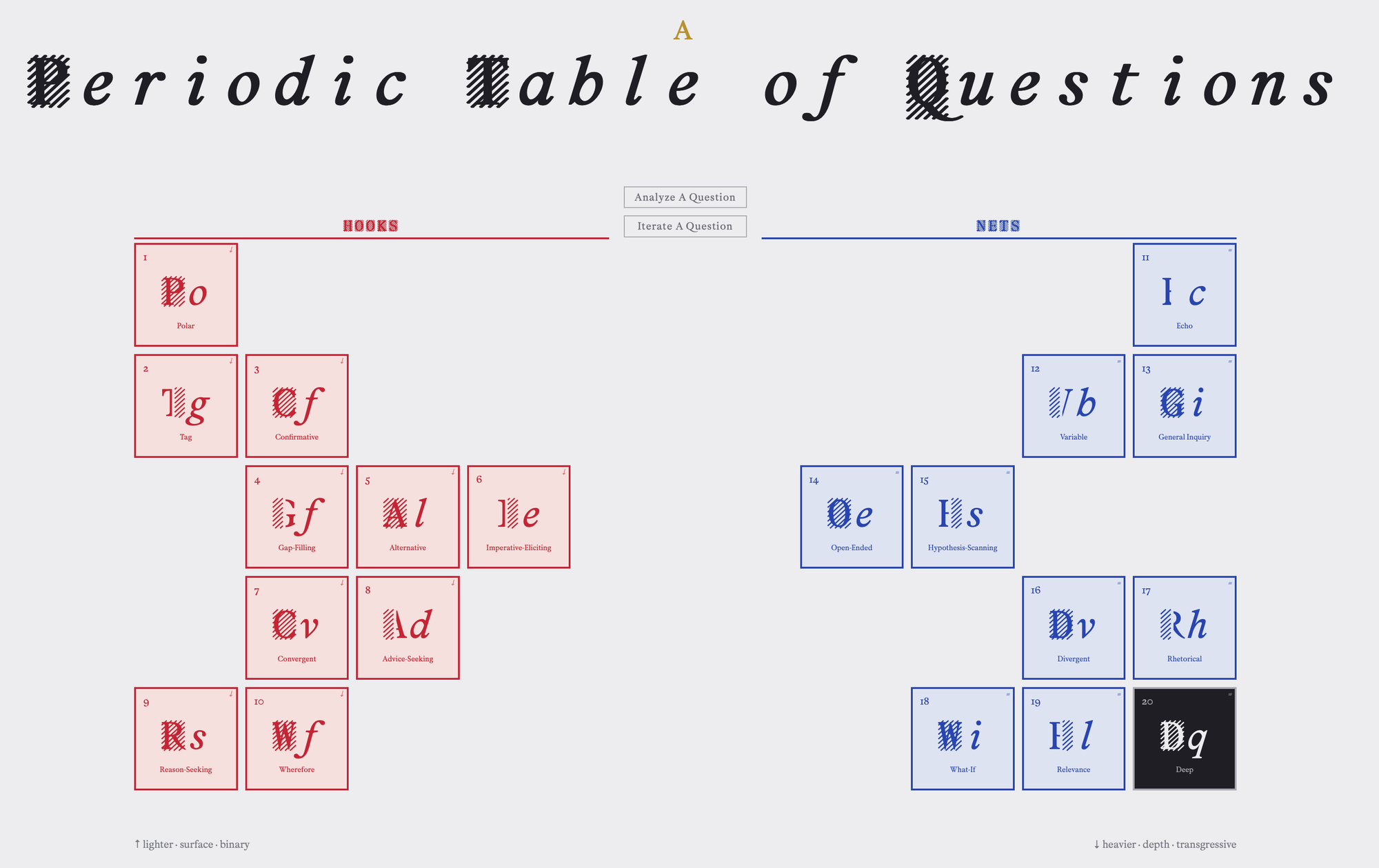
This is immediately interesting to click around. Click on each for an example question. Dan has a talk and draft book chapter available.
Also, it’s immediately useful. You can provide a question and the thing will guess what kind of question it is. You can ‘iterate’ a question and it’ll give you restated versions of your question across all 20 genres. (Must be some ill-begotten LLM device behind the scenes; re-roll if you don’t like what you see; use the cut-up method to swipe only the results that are meaningful to you. Meaning comes from you, not the randomization device.)
I told Dan it reminded me of ORID from the Institute for Cultural Affairs:
 Jo Nelson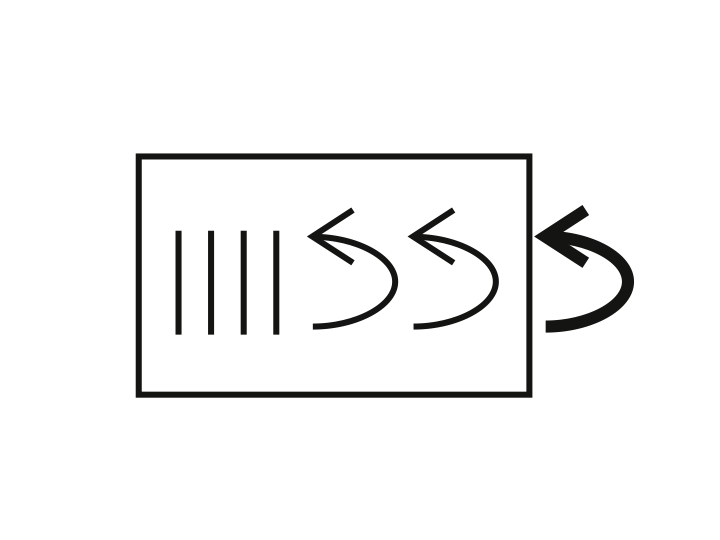
This is how ICA teachers advise a facilitator to arrange a ‘focused conversation’—one of several basic extremely valuable facilitation methods they teach. To design a focused conversation, you write up a sequence of questions in deliberate sequence across 4 levels: objective, reflective, interpretive, and (the most unlovely word of all) decisional. The Periodic Table of Questions has helped me arrange questions for one focused conversation so far, and I look forward to more. I do a good job of figuring out what the questions should be, but never want to slow down and get the wording just right. And one feature of the focused conversation is that if you have great questions in the right order, there is very little else to do. A group then brings itself to the appropriate ending point for a meeting or activity.
A simpler version of this approach, one which trades away a lot of nuance for being easier to do, is the ‘What, So What, Now What?’ (W3) liberating structure:
Keith McCandless, Henri Lipmanowicz
W3 is based in part on the work of Chris Argyris (who I’ve written about before—
Brian Kerr
—and whose writing and ideas I rely on in my consulting practice). The ladder of inference shared in the W3 method feels like a fast-and-loose alternative to ORID.
Simpler still is to ask a single question, my own shortcut method:
Brian Kerr
When this works, it is because starting with something at the “data” level (as per the ladder of inference), or the “objective” level (per ICA’s ORID/focused conversation), or the lighter/topmost “net” questions (per the Periodic Table of Questions) is always enough to get a conversation started, and often enough to keep a conversation moving along, of its own accord, to its conclusion.
One last point. Jerry Weinberg had remarkable advice about not inflicting help—by which he meant offering known, or supposed, answers before someone is ready to ask for help. Over the last 20 years, this idea has made all the difference for me. The distinction between being (a) this dreary little (presumed) know-it-all and (b) a helpful colleague. Which is to say: people might not want the answer to the question you wish they would ask, but they might listen to your question if you ask it with kind curiosity, in the right way, and at the right time.