


Skip to Content

Posts tagged with Podcast

On speeding things up

A cute little snake sunning itself on the woodpile.
Photo by Brian Kerr.

Learning from the hourglass & the snake.

audio-thumbnail
Podcast episode 0034: On speeding things up
0:00
/497.024

More podcast episodes online or in your favorite app.

People want to go faster. I’ve made my career helping people speed up things they care about: foster care placement, order-to-cash cycles, school transportation, weather radar rendering, customer support escalations, replacement part ordering, academic award selection, environmental site reviews, and on and on.

During these adventures, I learned two points about speed—one from the hourglass, the other from the snake.

1. The hourglass isn’t listening

Imagine an hourglass. Two glass bulbs, a skinny bottleneck connecting the two, an enclosed volume filled with sand.

  • The rate at which sand falls is controlled by the width of the bottleneck. This bottleneck is what makes it an hourglass, not a jar.
  • The hourglass is filled with an amount of sand, and an amount of air.
  • The duration it takes for the sand to fall from one side to the other is a function of these two: the rate at which sand passes through the bottleneck, and the amount of sand.

Hourglasses are compelling because all parts of the system are in clear view. To see an hourglass is to use it.

Complicated systems tend not to be self-documenting like this. It’s work to make the underlying rates, amounts, and durations they produce visible enough that they can then be adjusted with skill and care.

Bottlenecks & key constraints

The simplest way to adjust an hourglass is to add or remove sand. Sand is easier to change than glass.

You don’t make an hourglass run at a faster rate by yelling at the bottleneck, or putting it onto a performance improvement plan, or taking it to a baseball game. Tell the sand to do more with less and see where that gets you.

To adjust a complex system, first, figure out what the bottlenecks are. In this line of work, you might call them constraints. Go look, measure, count. Once you’ve found those constraints, get comfortable with them. There’s always a key constraint. Remove the key constraint and the second-worst constraint rises, smiling, to take its place. Continuous improvement is the practice of removing constraints, one at a time, without hurting anybody. Contrast this with typical improvement projects that merely push problems around until they are held by the unluckiest manager.

To adjust the system, you must discover the system under adjustment. We learn from the hourglass that it’s possible: rate, amount, duration.

2. The snake & its skin
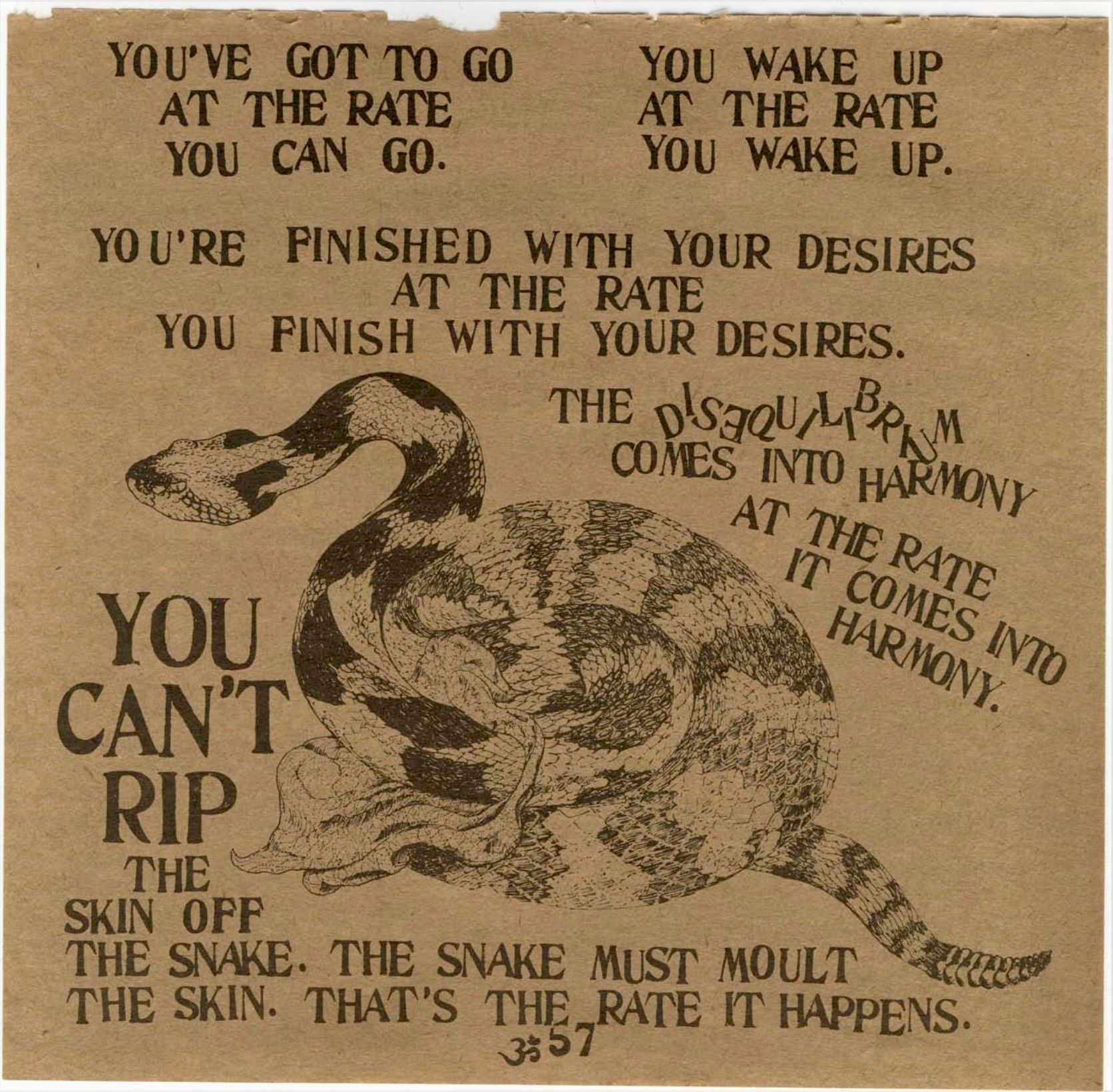
A page from ‘Be Here Now’ by Ram Dass (1971).

This page from Ram Dass’ Be Here Now helps me find patience. And patience makes me effective.

  • For example, on the meditation cushion, I appreciate and laugh off moments where I notice a desire to produce more stillness—and faster.
  • For example, when working with clients, I remember that things only happen at a certain rate, especially inside large, dysfunctional organizations, where people suffer under autocratic leadership, and where safety is neither established or maintained.
You can’t rip the skin off the snake.
The snake must moult the skin.
That’s the rate it happens.

Please don’t take this as discouragement against change. It is a reminder that each moment prefigures the next. Let us allow change to happen, to remain steadfast in our conviction that it will, and that we create the conditions for it, and that we’re not to rip the skin off the snake.


August 6, 2024: Edited for length.
Featured

5 ways to approach goal-setting. Only one is worth a damn

Sunset behind some wispy clouds. It’s a view of some mountains across a body of water.
Photo by Brian Kerr.

Better to have an impossible goal than one you meet-&-exceed always.

audio-thumbnail
Podcast episode 0038: 5 ways to approach goal-setting
0:00
/632.064

More podcast episodes online or in your favorite app.

A few games people play when it’s time to set goals:

Game #1

Set easy goals that are super attainable within the limits of current behavior. In this game, every goal is always met and nothing ever changes.

Game #2

Set goals that are more ambitious, but are less likely to be met. Real progress can be “hidden” behind partial progress towards unmet goals. But that is OK so long as everyone is playing the same game.

Game #3

Set goals at the theoretical limit. Error should be 0%. No one should be harmed. Everyone must be free.

Game #4

People loiter about, trying to figure out what kind of goal one is meant to set from various context clues, possibly inscrutable or obscured. Then, they play the appropriate game from the list above. Whatever you do, don’t guess wrong! Do what everybody else does, but a little more, but not too much!

Discussion

Of these, game #4 is the one I see played most frequently.

But as far as I’m concerned, game #3—setting goals at the theoretical limit—is the only one worth playing. Why? Because I never want errors to be OK. No one should be harmed. I’m in this for the liberation of all beings.

Cue the voice from the back of the room. Who are we kidding, it comes from the front of the room. This voice is heard to proclaim: “That’s not realistic!”

So yes, as a pragmatic concern, a lot of times people do want to see tidy little goals attained relentlessly, quarter after quarter. When I find myself in that scenario, I’ll play a new game:

Game #5

Near and far—Set a goal at the theoretical limit, describing the world we should have. Then, set a target that would inch the system’s performance toward the theoretical limit. This target is what we’ll commit to going after right now.

Three benefits of this game:

  • First, it creates space for small, incremental achievement. It is the zone of daily kaizen, of ongoing practice, and of continuous improvement.
  • Second, it allows for huge, transformational shifts—so long as people demonstrate improvements that move things closer to the goal, and there is a supportive management framework.
  • And third, it brings trade-offs into view.

Trade-offs revealed

Suppose we want a particular error rate to be 0%, and it’s at 50% right now. Half of the time, we do a thing and something screws up.

It’s likely that we can find small, reversible changes that brings that error rate down from 50%. Just ask the people who do it every day, they can tell you what to fix. Listen to them, do what they suggest. This is where a lot of projects are.

Now suppose that things have become better, but still not good enough. The error rate is now 5%. One out of twenty times, something screws up. We are in the zone where not everything we try will actually prevent errors. Or we might identify things that bring the error rate down further, but are not “worth it”—and there, is where the discussion happens:

  • What is acceptable harm, according to the people who sign the checks? At some point further improvements will be revealed to not be “worth it.”
  • What amount of pain, damage, loss, is an organization willing to actively produce in its regular workings?

Play this game, set goals at the theoretical limit, and eventually you’ll find out what the organization and its toleration really is.

August 1, 2024: Edited for length.