It’s the first Tuesday of the month—January 6, 2026. I remember where and how I was five years ago today: holed up in my office, up in the finished attic of our previous home, cold but cozy, laboring desperately and fruitlessly to finish some mildly overdue items for a client, making no progress whatsoever, instead watching video feeds on C-SPAN and texting furiously with Liana and various friends. My consulting partner on that project (hi Jennifer! miss you & hope you are well) created a little wiggle room for us that day. People die only the once, but ideals fall again and again, and either way the absence and grief is felt whole-heartedly.
Yesterday was the first day back at work for many of us who had the good fortune to enjoy some downtime or time away around the end of the year. I felt tense going into the weekend, not from apprehension about returning to work but rather from worry about what they’d do on—or for—the fifth anniversary of January 6. I needn’t have waited. In 1992 Leonard Cohen sang that he couldn’t “run no more with that lawless crowd / while the killers in high places say their prayers out loud.” In the current circumstance the killers skipped the praying in favor of congregating in front of a wall-sized display with results of a search on X dot com for ‘Venezuela.’
Square that with the expectation that work happens underneath a context-free, ahistorical capitalist realism dome; in this dome the past is about two months long and the future extends only as far out as the end of the quarter or the next round of asinine bulk layoffs. I see cracks in the dome. I wonder what might shine through.
Three responses
How to respond in these conditions? I see three ways:
The first response is to remember. I wrote recently about undiscussables and shifting baselines. In both cases I think this is what I was really on about. We have to remember this, so we can give an account of what happened, and hold to account those responsible, and produce a better place in its aftermath, restoring rights and generating protections for all.
Another is to take time & show care. People are hurting, worried, scared. These are best antidotes I know of, at least on a the scale of local, daily interactions.
Taking time: this looks like 90 minutes with friends instead of 60; showing up early to arrange chairs and cushions into an inviting circle; and joining a few calls or meetings that are not strictly necessary but I hope will be beneficial.
Showing care: helping people around me ease back into things. At work this means a deliberate, gentle reiteration of commitments and arrangements. What have we all signed up for? By what method will we try to it get it done? We might adjust as needed, but largely I think people just need to hear it again.
A final response is to do what we can. My city elected its new mayor, someone I know and respect and for whose campaign our whole family was proud to volunteer. He’ll be sworn in at the top of tonight’s city council meeting. There is a sense that this is the start of something good, despite the limitations of that position and other constraints in place.
These three are incomplete, but it’s what I have, and how I’m operating right now.
The original tagline for this site and newsletter was ‘continuous improvement in a world that’s one damn thing after another.’ Today let’s revisit that last bit. What does it mean for a world to be one damn thing after another? And what does this have to do with the potential for continuous improvement, or the possibility of provision?
Something fishy
In 1995 fisheries scientist Daniel Pauly (by this time 20 years into his career and already a prolific author) wrote a one-pager published on the back page of an obscure biology journal.
This was the location of one of the biggest, gloomiest ideas going. Pauly described a ‘shifting baseline syndrome’ affecting his profession:
This syndrome has arisen because each generation of fisheries scientists accepts as a baseline the stock size and species composition that occurred at the beginning of their careers, and uses this to evaluate changes. When the next generation starts its career, the stocks have further declined, but it is the stocks at that time that serve as a new baseline. The result obviously is a gradual shift of the baseline, a gradual accommodation of the creeping disappearance of resource species, and inappropriate reference points for evaluating economic losses resulting from overfishing, or for identifying targets for rehabilitation measures.
Pauly viewed this as a generational ‘shift’ to be countered with careful data collection and analysis. These countermeasures would occupy much of his time and publication schedule for the rest of his career.
The blissfully boiling frog
When I first read this article some years ago, it really stuck with me. It seemed to explain a lot. But I wondered:
Might it explain more, and more broadly? Doesn’t everybody do this?
And at a faster pace than the gradual, generational cycles under discussion? I believed then, and believe now, that people can get used to just about anything. The evidence is all around us.
I also worried that expanding the idea of ‘shifting baselines’ beyond Pauly’s original scope would lead to nostalgia. There are many important ways in which the present is better than the past, even as we rush to forget what has passed away.
Eventually I poked around the archive. No surprise that Pauly continued to think and write about this big, gloomy idea.
In 2011—sixteen years after ‘shifting baselines’—he wrote:
Without firm rooting in scientific, quantified knowledge of what we now have, or had, we will inevitably experience the ‘shifting baseline syndrome.’ As I have described, successive generations of naturalists, ecologists, or even Nature lovers use the state of the environment at the beginning of their conscious interactions with it as the reference point, which then shifts as successive generations degrade that same environment. The story of the frog kept in water that is heated very slowly comes to mind here, and if we are not careful, we are going to get boiled as the frog does: a runaway greenhouse effect would do the job nicely.
I found here in the 2011 writing the broadened scope, the boiling frog, and the slow-but-fast progression of human-caused climate change that is the defining feature of our century.
The decade-scale example is excess deaths caused by COVID-19. We never did a great job tracking mortality due to COVID. Instead, we mostly stopped counting 3 years ago, and mostly stopped estimating one year ago, as the body count neared 30 million. There is a huge impulse to forget and to move along, although insurance companies remember. (Thanks to Susannah for these links.) Is this another aspect of shifting baselines? Despite, alongside, and during this unsurpassed tragedy, we continue to care for the people in our lives and provide and labor in community. What the hell else would we do? Emerson wrote that “we learn geology the morning after the earthquake.” This is true; also true is that only a few days or years pass before the “cloven mountains, upheaved plains, and the dry bed of the sea” become as unremarkable as any other feature of our surroundings. A disaster as invisible as any other.
Pauly made an additional point—also revealed to me by my friend Summer:
For baselines to shift is not always bad. There are many stupid things that must be forgotten even if they have been the rule for thousands of years. Getting rid of these notions will free our minds and enable us to concentrate on things that matter, including some important things that we should remember.
Forgetting, remembering—and in Pauly’s discussion, forgetting some things in order to remember others. All baselines can shift. It seems that most will. But a few must not, lest we lose our footing during the ongoing scramble toward liberation. This is the idea. It is big, and it is gloomy.
📖
These 2011 quotes are from a book chapter called “On baselines that need shifting.” It is reprinted in Pauly’s 2019 book Vanishing Fish.
Shifting baselines in the workplace
This is not mere theory. I see it in my daily efforts as a consultant supporting people in their work and in their workplaces.
The conditions of shifting baseline syndrome—of vast, continual retrenchment of natural and built and social environments—are those under which people work. Even if undiscussable, it’s ever-present.
As someone who lives and works in the US, this has only accelerated in our current bad times. The Christian fascists in power have an agenda that depends on baselines shifting quickly and broadly. Whether people resist and ignore this—or, as a minority do, accept it—the effort keeps everyone distracted and uncomfortable.
Finally, certain ultra-Amazonified workplaces intentionally leverage the ‘shifting baseline syndrome’ to get staff to accept bad policy, missing strategy, poorly leveled workloads, and so forth.
If employees are to perform inside these settings, they must develop a context-free, history-less pragmatism.
Some people will shift to accommodate.
Other people will wash out.
Either way, the corporation gets what it wants.
I don’t have answers to any of this. But I find it helpful to remember that these are the conditions people are in.
Pauly’s closing advice
Let’s give Pauly the last word. He ended his 2019 book Vanishing Fish with an offer of advice, which—after all of the above—I was eager to accept. His advice is honest and true. I suppose time will tell whether it is sufficient. Pauly wrote:
If I have any advice to give, it is that one should have friends and work hard.
You write sitting in the back garden, where the barest breeze is enough to rustle the limbs and leaves of the fruit trees, to raise a little hiss from the tall grasses, and to awake a larger, fuller breathing from all the trees beyond. You hear the chittering of birds jockeying for position at the feeder, or the occasional squabble of gulls or crows. A fence gate clacks, a vehicle revs, an airplane passes low on its return to base. You hear the sound of your fingers hitting keys on the keyboard, even though you use the quietest keyboard money can buy. You hear your breathing and the rustling of your linen shirt. You hear your teeth grinding, which is how you know you’re lost in thought.
That’s quiet. It’s active, it’s noisy, it never stops. Even in a perfectly still, empty house there is an ongoing tumble of things to hear.
But—there’s something else entirely. Take out your hearing aids, set them aside. So much drops away. The breeze becomes a pattern of pressure and temperature on your skin, in your hair. This is the real silence, the silence that opens up once you shut down all the hissing, buzzing quiet. For a little while, you don’t have to worry about how much work it is to listen to people. You don’t have to adjust position, posture, device settings at the beginning and end of every single conversation, forever. You can unhook the 20% of your awareness that is held to listen for voices, always standing by to begin the energetic work of listening.
Being tired
I am usually tired after a day of work—especially onsite—because listening to people is hard.
On the one hand, I love listening to people, because people are interesting, and listening is one of the best ways to learn about them (the other best way is watching). And my whole thingy of reducing suffering and wasted effort across an organization depends on getting people to speak with one another.
On the other hand, listening to speech is something that so far as I can tell comes easily to most people, but is a lot of effort for me. Reading is easy. Listening is hard. That’s just the way it is.
Being lucky
I’m lucky that I was born where and when I was, and to be part of a supportive family with resources. I started using assistive technology when I was a toddler. The pile accumulates and updates as I age: fewer knobs, more touch-screens. My first hearing aids were unlovely wasp-like devices to catch and boost sound in delicate little curves mirror-matched to my hearing loss. Machines for converting an expensive, wasteful heap of disposable batteries into speech, music, the clatter of life. Over the decades the hearing aids have become accessories to everything else—to the car, to the computer, to the iPad. My iPhone doubles as a discreet little roving mic to pick up what you’re saying in that noisy cafe. You put your phone on the table for whatever reason. I put my phone on the table to hear what you say.
Being a talking animal
As a child I read Carl Sagan’s “Cosmos”:
We are the local embodiment of a Cosmos grown to self-awareness. We have begun to contemplate our origins: starstuff pondering the stars; organized assemblages of ten billion billion billion atoms considering the evolution of atoms; tracing the long journey by which, here at least, consciousness arose. Our loyalties are to the species and the planet. We speak for Earth. Our obligation to survive is owed not just to ourselves but also to that Cosmos, ancient and vast, from which we spring.
I read Albert Camus’ “The Myth of Sisyphus”:
At this point of his effort man stands face to face with the irrational. He feels within him his longing for happiness and for reason. The absurd is born of this confrontation between the human need and the unreasonable silence of the world. This must not be forgotten. This must be clung to because the whole consequence of a life can depend on it.
For most of my life, I thought this was the project: to obliterate the silence of the world, offensive in its mere presence, by filling it up with speech, and to use speech to do good things. To speak for the earth, since (after Rorty) the world does not speak, only we do.
Being comfortable
In 2022, I sat a silent meditation retreat for a week, my first time practicing at that duration and intensity. It was an important experience, and I also complained about it a lot. The first day or two or three I really struggled as I found myself alone in our very quiet family cabin. The longer I sat the more noisy and rattly it all became. At a certain point I pulled out my hearing aids and that made all the difference. I could rest.
The silence I expend so much effort and money to dispel became exactly what I now wanted to sit with. I couldn’t hear the daily chants or the heart sutra with my friends in the Zoom sangha, but that was OK—I knew what we were saying. On that retreat I realized how much work I put into listening, even when there is no need to hear, or nothing to listen for. That silence produced stillness, and in sitting I fell away from the logics of attainment and progression that had haunted me for decades (and still do).
I used to get deeply unhappy or funky when I couldn’t wear my hearing aids for whatever reason. But these days—here’s my secret—the instant I am alone, out they go. I want the world to be safe and lovely and a place of liberation and flourishing for everybody, and I feel somehow closest to that world when I am in the world of silence. I also want to sit and talk with people and listen to them all day every day—to chat ceaselessly with my friends, to gossip with everyone at work, to learn what my past clients are up to, to listen to one child give an artist’s statement for his most recent tongue-preserver-and-colored-pencil apparatus, or to, at nighttime, listen to the other child practice his violin, or to Liana singing and playing guitar.
They say the body is a city with nine gates.
Two of mine happen to be a little finicky.
I truly believe that if I could begin again at life with a body that could hear better, or more typically, I wouldn’t go for it. While I might have an easier time and have fewer large out-of-pocket expenditures, I just don’t know what it’d be like to live in the world of hearing. It’s a wonderful place to visit. But the world of silence is where I began and where, I think, I will end. It’s the underlying fact of my life. And I have a good life; I do good work.
It’s on that basis I embrace disability, and my disability, and—this month—disability pride.
July 2, 2025: Edited to add the following dismal 2025 coda. ↓
Dismal 2025 coda
As I revisit this piece from 2023, I stand by everything in it.
But a few updates are in order:
In 2024 I was lucky enough to do another week-length silent retreat and reconnected with that deep silence. I am so grateful for that experience.
Just last month, in June 2025, I paid cash out of pocket for newer, fancier hearing aids. Rule-making by Joe Biden’s FDA increased the range of options available to me and dramatically decreased my costs.
And as I write these words on July 2, 2025, Republicans in the US Congress are scrounging together the remaining votes they need to pass the ‘big beautiful bill’ containing (in addition to every other awful thing) numerous specific attacks on services, protections, and basic health care for people with disabilities. This is a particularly intense moment in that regard. But today, this week, this season, is also part of their larger, ongoing project of excluding, denationalizing, and dehumanizing anybody that doesn’t fit into their specifically chicken-hearted, incoherent Christian Nationalist nightmare vision. It is in this context that we celebrate Disability Pride Month this year.
Identify project risks using this fun, thought-provoking 15-minute method to capture wisdom from the people who know best—those who will do the work and those who will be affected by it.
It’s the venerable project premortem.
I recommend this method if you’re leading a project in your own organization. And if you’re a consultant, like me, it can be a significant information-seeking behavior at the beginning of a project.
The underlying capability is prospective hindsight. Here’s a definition from Gary Klein, in his HBR piece from 2007 on premortems:
Prospective hindsight—imagining that an event has already occurred—increases the ability to correctly identify reasons for future outcomes by 30%. We have used prospective hindsight to devise a method called a premortem, which helps project teams identify risks at the outset.
The premortem is not a new idea—this 2007 article popularized the technique. However, I keep using it because each time I do, I learn things that are valuable to know at the beginning of a new project—and particularly with a new client.
The power of the premortem is this:
People will just tell you things if you ask them nicely.
And if you ask using prospective hindsight, they will come up with surprising answers, sometimes even mentioning their organization’s ‘undiscussables.’
A few things I’ve learned from premortems
That the current effort was the second attempt, and therefore doomed to failure for the same reasons the first effort failed.
That the current effort was the third attempt, etc.
The existence of a specific policy making the intended change impossible, and that policy-makers were not involved in designing or selecting the project.
That the ongoing budget to support this work had already been allocated to a particular technology, program, or team.
That people don’t trust or believe their leadership, or the project’s sponsors, or one another.
Various discoveries about organizational problems in communication and clumsiness in making changes.
These were all things worth learning quickly—as in, cheap and early—so that possibilities remained for adjustment or better awareness of the environment.
Here’s how it’s done: running your premortem
Before the meeting, write a simple scenario. Something like: “It is December and our project has failed spectacularly. As the first snow falls, we gather together and ask—what happened? Why did this fail?” Be precise about the future date: maybe 2 months after the presumed project completion; link the date to some major event or local seasonality.
Schedule 15 minutes in a project kick-off meeting to run the premortem.
At the start of the premortem, state the scenario and ask the question.
Allow 1-3 minutes for individual reflection.
Offer an anonymous feedback form and invite participants to provide their responses. Clearly state how you will use these, for example, that individual responses remain anonymous, but you will share themes and takeaways with the group and with project sponsors.
After the individual reflection time is complete, open up for a brief discussion across whatever participation modes are available. Acknowledge and thank people for their responses. Do not attempt to problem-solve or diagnose right now, but make it clear you’ll be doing so later. If project sponsors, execs, etc. attend, you will have to coach them on this behavior in advance, the message being: we’re listening now, we’ll problem-solve afterwards.
Close with sincere thanks and by telling people where and when you’ll share takeaways from the premortem—ideally with planned remediations for each.
An encouragement
The project premortem concept may seem a little weird. It is.
But it’s a great way to show up and listen. The simple act of listening to people and adjusting based on what you hear is wonderful.
And, almost as a side effect, the things people mention might be the things that doom the project to failure—or the things that, adjusted and kept in mind, might make it a great success.
October 7, 2025: Edited for length & added new photo.
People want to go faster. I’ve made my career helping people speed up things they care about: foster care placement, order-to-cash cycles, school transportation, weather radar rendering, customer support escalations, replacement part ordering, academic award selection, environmental site reviews, and on and on.
During these adventures, I learned two points about speed—one from the hourglass, the other from the snake.
1. The hourglass isn’t listening
Imagine an hourglass. Two glass bulbs, a skinny bottleneck connecting the two, an enclosed volume filled with sand.
The rate at which sand falls is controlled by the width of the bottleneck. This bottleneck is what makes it an hourglass, not a jar.
The hourglass is filled with an amount of sand, and an amount of air.
The duration it takes for the sand to fall from one side to the other is a function of these two: the rate at which sand passes through the bottleneck, and the amount of sand.
Hourglasses are compelling because all parts of the system are in clear view. To see an hourglass is to use it.
Complicated systems tend not to be self-documenting like this. It’s work to make the underlying rates, amounts, and durations they produce visible enough that they can then be adjusted with skill and care.
Bottlenecks & key constraints
The simplest way to adjust an hourglass is to add or remove sand. Sand is easier to change than glass.
You don’t make an hourglass run at a faster rate by yelling at the bottleneck, or putting it onto a performance improvement plan, or taking it to a baseball game. Tell the sand to do more with less and see where that gets you.
To adjust a complex system, first, figure out what the bottlenecks are. In this line of work, you might call them constraints. Go look, measure, count. Once you’ve found those constraints, get comfortable with them. There’s always a key constraint. Remove the key constraint and the second-worst constraint rises, smiling, to take its place. Continuous improvement is the practice of removing constraints, one at a time, without hurting anybody. Contrast this with typical improvement projects that merely push problems around until they are held by the unluckiest manager.
To adjust the system, you must discover the system under adjustment. We learn from the hourglass that it’s possible: rate, amount, duration.
2. The snake & its skin
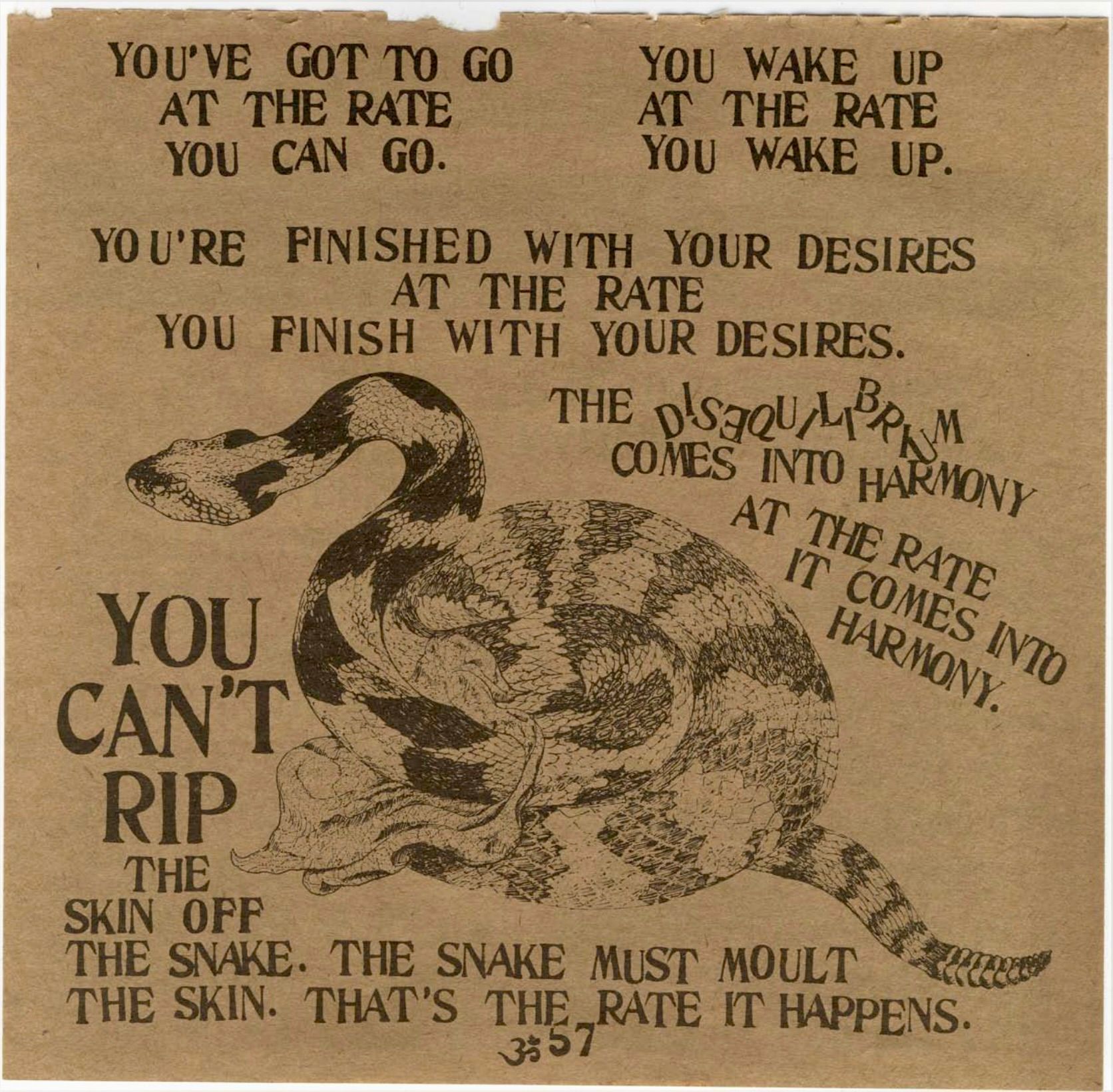
A page from ‘Be Here Now’ by Ram Dass (1971).
This page from Ram Dass’ Be Here Now helps me find patience. And patience makes me effective.
For example, on the meditation cushion, I appreciate and laugh off moments where I notice a desire to produce more stillness—and faster.
For example, when working with clients, I remember that things only happen at a certain rate, especially inside large, dysfunctional organizations, where people suffer under autocratic leadership, and where safety is neither established or maintained.
You can’t rip the skin off the snake. The snake must moult the skin. That’s the rate it happens.
Please don’t take this as discouragement against change. It is a reminder that each moment prefigures the next. Let us allow change to happen, to remain steadfast in our conviction that it will, and that we create the conditions for it, and that we’re not to rip the skin off the snake.