



More podcast episodes online or in your favorite app.
People want to go faster. I’ve made my career helping people speed up things they care about: foster care placement, order-to-cash cycles, school transportation, weather radar rendering, customer support escalations, replacement part ordering, academic award selection, environmental site reviews, and on and on.
During these adventures, I learned two points about speed—one from the hourglass, the other from the snake.
1. The hourglass isn’t listening
Imagine an hourglass. Two glass bulbs, a skinny bottleneck connecting the two, an enclosed volume filled with sand.
- The rate at which sand falls is controlled by the width of the bottleneck. This bottleneck is what makes it an hourglass, not a jar.
- The hourglass is filled with an amount of sand, and an amount of air.
- The duration it takes for the sand to fall from one side to the other is a function of these two: the rate at which sand passes through the bottleneck, and the amount of sand.
Hourglasses are compelling because all parts of the system are in clear view. To see an hourglass is to use it.
Complicated systems tend not to be self-documenting like this. It’s work to make the underlying rates, amounts, and durations they produce visible enough that they can then be adjusted with skill and care.
Bottlenecks & key constraints
The simplest way to adjust an hourglass is to add or remove sand. Sand is easier to change than glass.
You don’t make an hourglass run at a faster rate by yelling at the bottleneck, or putting it onto a performance improvement plan, or taking it to a baseball game. Tell the sand to do more with less and see where that gets you.
To adjust a complex system, first, figure out what the bottlenecks are. In this line of work, you might call them constraints. Go look, measure, count. Once you’ve found those constraints, get comfortable with them. There’s always a key constraint. Remove the key constraint and the second-worst constraint rises, smiling, to take its place. Continuous improvement is the practice of removing constraints, one at a time, without hurting anybody. Contrast this with typical improvement projects that merely push problems around until they are held by the unluckiest manager.
To adjust the system, you must discover the system under adjustment. We learn from the hourglass that it’s possible: rate, amount, duration.
2. The snake & its skin
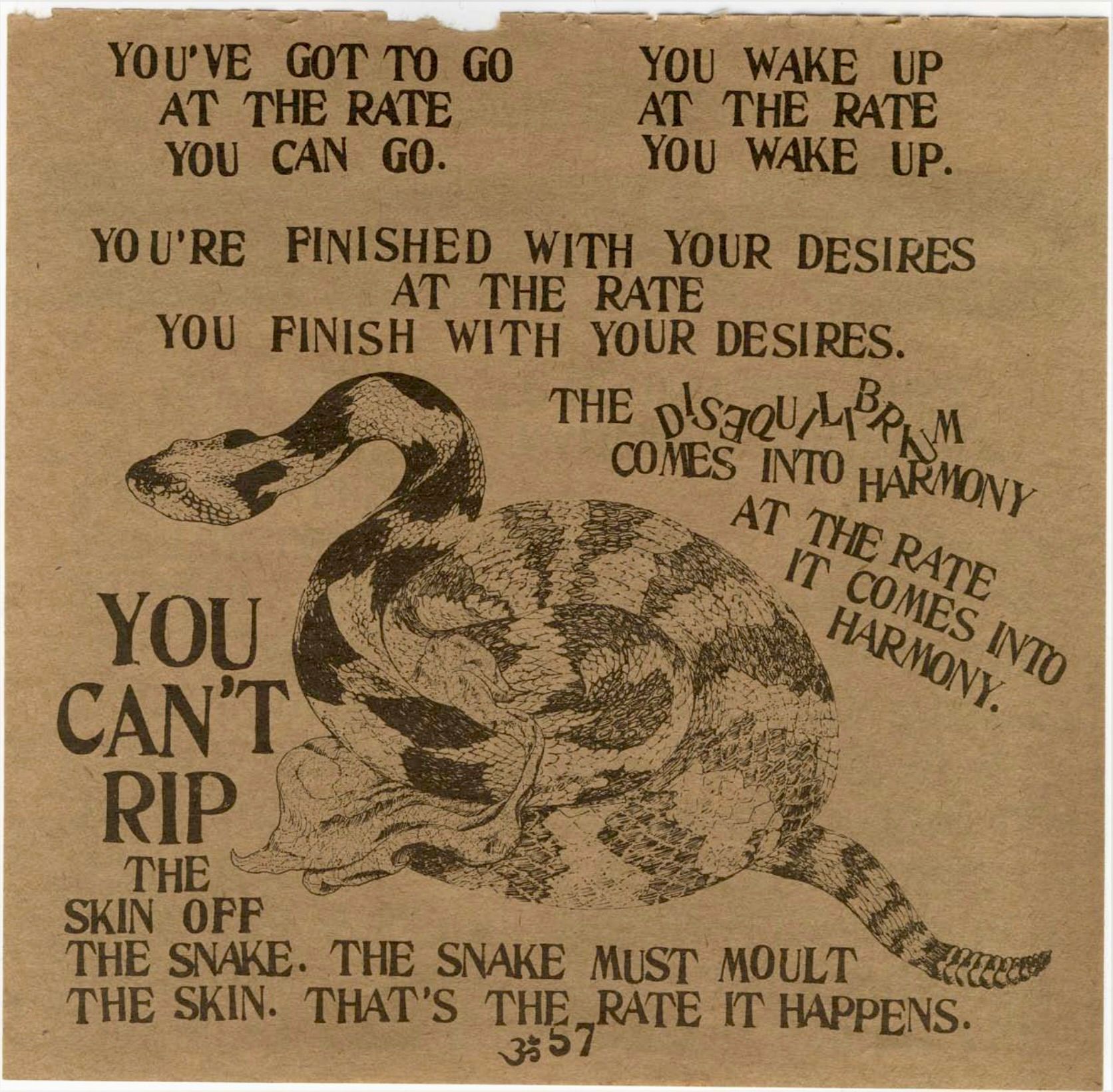
This page from Ram Dass’ Be Here Now helps me find patience. And patience makes me effective.
- For example, on the meditation cushion, I appreciate and laugh off moments where I notice a desire to produce more stillness—and faster.
- For example, when working with clients, I remember that things only happen at a certain rate, especially inside large, dysfunctional organizations, where people suffer under autocratic leadership, and where safety is neither established or maintained.
You can’t rip the skin off the snake.
The snake must moult the skin.
That’s the rate it happens.
Please don’t take this as discouragement against change. It is a reminder that each moment prefigures the next. Let us allow change to happen, to remain steadfast in our conviction that it will, and that we create the conditions for it, and that we’re not to rip the skin off the snake.