Skip to Content

Posts tagged with Continuous improvement

Premortem: before starting a new project, learn why it will end in failure

A walking path through a forested gulch. A neighborhood bridge goes overhead, partially obscured by the trees.
Photo by Brian Kerr.

A simple method for uncovering big, ‘undiscussable’ risks to a project.

audio-thumbnail
Podcast episode 0035: Premortem
0:00
/547.264

More podcast episodes online or in your favorite app.

Identify project risks using this fun, thought-provoking 15-minute method to capture wisdom from the people who know best—those who will do the work and those who will be affected by it.

It’s the venerable project premortem.

I recommend this method if you’re leading a project in your own organization. And if you’re a consultant, like me, it can be a significant information-seeking behavior at the beginning of a project.

The underlying capability is prospective hindsight. Here’s a definition from Gary Klein, in his HBR piece from 2007 on premortems:

Prospective hindsight—imagining that an event has already occurred—increases the ability to correctly identify reasons for future outcomes by 30%. We have used prospective hindsight to devise a method called a premortem, which helps project teams identify risks at the outset.

The premortem is not a new idea—this 2007 article popularized the technique. However, I keep using it because each time I do, I learn things that are valuable to know at the beginning of a new project—and particularly with a new client.

The power of the premortem is this:

  1. People will just tell you things if you ask them nicely.
  2. And if you ask using prospective hindsight, they will come up with surprising answers, sometimes even mentioning their organization’s ‘undiscussables.’

A few things I’ve learned from premortems

  • That the current effort was the second attempt, and therefore doomed to failure for the same reasons the first effort failed.
  • That the current effort was the third attempt, etc.
  • The existence of a specific policy making the intended change impossible, and that policy-makers were not involved in designing or selecting the project.
  • That the ongoing budget to support this work had already been allocated to a particular technology, program, or team.
  • That people don’t trust or believe their leadership, or the project’s sponsors, or one another.
  • Various discoveries about organizational problems in communication and clumsiness in making changes.

These were all things worth learning quickly—as in, cheap and early—so that possibilities remained for adjustment or better awareness of the environment.

Here’s how it’s done: running your premortem

  1. Before the meeting, write a simple scenario. Something like: “It is December and our project has failed spectacularly. As the first snow falls, we gather together and ask—what happened? Why did this fail?” Be precise about the future date: maybe 2 months after the presumed project completion; link the date to some major event or local seasonality.
  2. Schedule 15 minutes in a project kick-off meeting to run the premortem.
  3. At the start of the premortem, state the scenario and ask the question.
  4. Allow 1-3 minutes for individual reflection.
  5. Offer an anonymous feedback form and invite participants to provide their responses. Clearly state how you will use these, for example, that individual responses remain anonymous, but you will share themes and takeaways with the group and with project sponsors.
  6. After the individual reflection time is complete, open up for a brief discussion across whatever participation modes are available. Acknowledge and thank people for their responses. Do not attempt to problem-solve or diagnose right now, but make it clear you’ll be doing so later. If project sponsors, execs, etc. attend, you will have to coach them on this behavior in advance, the message being: we’re listening now, we’ll problem-solve afterwards.
  7. Close with sincere thanks and by telling people where and when you’ll share takeaways from the premortem—ideally with planned remediations for each.

An encouragement

The project premortem concept may seem a little weird. It is.

But it’s a great way to show up and listen. The simple act of listening to people and adjusting based on what you hear is wonderful.

And, almost as a side effect, the things people mention might be the things that doom the project to failure—or the things that, adjusted and kept in mind, might make it a great success.

October 7, 2025: Edited for length & added new photo.

Merely being the person you are

An iron gate is open on both sides of a gravel road heading down into a thick forest.
Photo by Brian Kerr.

The consulting advice that made me a better person & a more effective consultant.

A passage from Jerry Weinberg’s The Secrets of Consulting:

Your ideal form of influence is first to help people see their world more clearly, and then to let them decide what to do next. Your methods of working are always open for display and discussion with your clients. Your primary tool is merely being the person you are, so your most powerful method of helping other people is to help yourself.

I first read Jerry Weinberg around 15 years ago, at a time when I was comfortable working as an independent consultant, but remained deeply uncomfortable with existing in the world as a human being. I wasn’t yet ready to take seriously the projects of caring for myself, or for others, or understanding what it was like to be a person.

That passage really stuck with me. Let’s read it together.

“Your ideal form of influence is first to help people see their world more clearly, and then to let them decide what to do next.”

The best job description for my kind of work that I’ve ever seen. It opens questions like:

  • Which people? Who is excluded yet should be included?
  • What constitutes their world?
  • How do they make that world intelligible to themselves or to others?
  • How might they (as a group) produce explanations, find consensus, or make a decision and stick to it?

“Your methods of working are always open for display and discussion with your clients.”

If we’ve worked together, you know what this is like. The garage door is up, where somebody is always making a mess and then cleaning it up so it shines.

As a consultant, I will come and I will go. After I’m gone, I hope some of the methods of working I demonstrated might be retained. This is why I enjoy cycling through approaches, methods, and techniques. At the start of an activity, neither you nor I know what will work best, but we can hope to uncover it together.

“Your primary tool is merely being the person you are, so your most powerful method of helping other people is to help yourself.”

It’s only in the last few years that I’ve come to recognize myself as an object truly capable of being helped, much less being worth the effort. Weinberg’s words gave me an important, early reason, which I now see as evidence of how deeply damaged I was (and still am) as a subject of capitalism. But that’s fine: you’ve got to go at the rate you can go.

These days, I work to keep things quiet in my head, so I can listen carefully to others. I sit still on my cushion so I can get up and move skillfully. I practice kindness so I can act kindly. Would it be better if I had come to these on my own, or earlier? Certainly. But I am grateful they came when they did.

No two go by one way; this one was mine.

Thanks, Jerry.

On speeding things up

A cute little snake sunning itself on the woodpile.
Photo by Brian Kerr.

Learning from the hourglass & the snake.

audio-thumbnail
Podcast episode 0034: On speeding things up
0:00
/497.024

More podcast episodes online or in your favorite app.

People want to go faster. I’ve made my career helping people speed up things they care about: foster care placement, order-to-cash cycles, school transportation, weather radar rendering, customer support escalations, replacement part ordering, academic award selection, environmental site reviews, and on and on.

During these adventures, I learned two points about speed—one from the hourglass, the other from the snake.

1. The hourglass isn’t listening

Imagine an hourglass. Two glass bulbs, a skinny bottleneck connecting the two, an enclosed volume filled with sand.

  • The rate at which sand falls is controlled by the width of the bottleneck. This bottleneck is what makes it an hourglass, not a jar.
  • The hourglass is filled with an amount of sand, and an amount of air.
  • The duration it takes for the sand to fall from one side to the other is a function of these two: the rate at which sand passes through the bottleneck, and the amount of sand.

Hourglasses are compelling because all parts of the system are in clear view. To see an hourglass is to use it.

Complicated systems tend not to be self-documenting like this. It’s work to make the underlying rates, amounts, and durations they produce visible enough that they can then be adjusted with skill and care.

Bottlenecks & key constraints

The simplest way to adjust an hourglass is to add or remove sand. Sand is easier to change than glass.

You don’t make an hourglass run at a faster rate by yelling at the bottleneck, or putting it onto a performance improvement plan, or taking it to a baseball game. Tell the sand to do more with less and see where that gets you.

To adjust a complex system, first, figure out what the bottlenecks are. In this line of work, you might call them constraints. Go look, measure, count. Once you’ve found those constraints, get comfortable with them. There’s always a key constraint. Remove the key constraint and the second-worst constraint rises, smiling, to take its place. Continuous improvement is the practice of removing constraints, one at a time, without hurting anybody. Contrast this with typical improvement projects that merely push problems around until they are held by the unluckiest manager.

To adjust the system, you must discover the system under adjustment. We learn from the hourglass that it’s possible: rate, amount, duration.

2. The snake & its skin

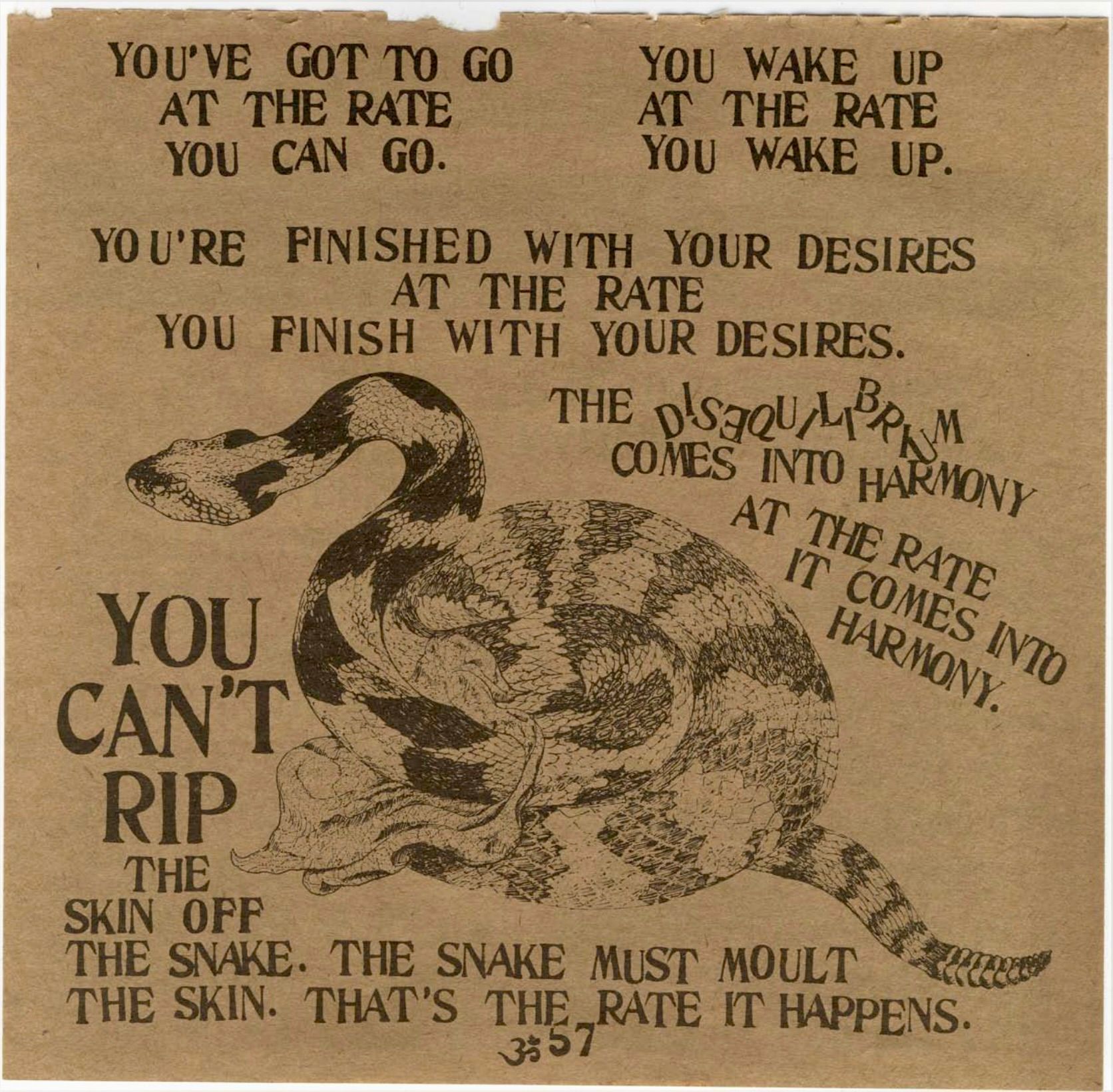
A page from ‘Be Here Now’ by Ram Dass (1971).

This page from Ram Dass’ Be Here Now helps me find patience. And patience makes me effective.

  • For example, on the meditation cushion, I appreciate and laugh off moments where I notice a desire to produce more stillness—and faster.
  • For example, when working with clients, I remember that things only happen at a certain rate, especially inside large, dysfunctional organizations, where people suffer under autocratic leadership, and where safety is neither established or maintained.
You can’t rip the skin off the snake.
The snake must moult the skin.
That’s the rate it happens.

Please don’t take this as discouragement against change. It is a reminder that each moment prefigures the next. Let us allow change to happen, to remain steadfast in our conviction that it will, and that we create the conditions for it, and that we’re not to rip the skin off the snake.

August 6, 2024: Edited for length.
Featured

5 ways to approach goal-setting. Only one is worth a damn

Sunset behind some wispy clouds. It’s a view of some mountains across a body of water.
Photo by Brian Kerr.

Better to have an impossible goal than one you meet-&-exceed always.

audio-thumbnail
Podcast episode 0038: 5 ways to approach goal-setting
0:00
/632.064

More podcast episodes online or in your favorite app.

A few games people play when it’s time to set goals:

Game #1

Set easy goals that are super attainable within the limits of current behavior. In this game, every goal is always met and nothing ever changes.

Game #2

Set goals that are more ambitious, but are less likely to be met. Real progress can be “hidden” behind partial progress towards unmet goals. But that is OK so long as everyone is playing the same game.

Game #3

Set goals at the theoretical limit. Error should be 0%. No one should be harmed. Everyone must be free.

Game #4

People loiter about, trying to figure out what kind of goal one is meant to set from various context clues, possibly inscrutable or obscured. Then, they play the appropriate game from the list above. Whatever you do, don’t guess wrong! Do what everybody else does, but a little more, but not too much!

Discussion

Of these, game #4 is the one I see played most frequently.

But as far as I’m concerned, game #3—setting goals at the theoretical limit—is the only one worth playing. Why? Because I never want errors to be OK. No one should be harmed. I’m in this for the liberation of all beings.

Cue the voice from the back of the room. Who are we kidding, it comes from the front of the room. This voice is heard to proclaim: “That’s not realistic!”

So yes, as a pragmatic concern, a lot of times people do want to see tidy little goals attained relentlessly, quarter after quarter. When I find myself in that scenario, I’ll play a new game:

Game #5

Near and far—Set a goal at the theoretical limit, describing the world we should have. Then, set a target that would inch the system’s performance toward the theoretical limit. This target is what we’ll commit to going after right now.

Three benefits of this game:

  • First, it creates space for small, incremental achievement. It is the zone of daily kaizen, of ongoing practice, and of continuous improvement.
  • Second, it allows for huge, transformational shifts—so long as people demonstrate improvements that move things closer to the goal, and there is a supportive management framework.
  • And third, it brings trade-offs into view.

Trade-offs revealed

Suppose we want a particular error rate to be 0%, and it’s at 50% right now. Half of the time, we do a thing and something screws up.

It’s likely that we can find small, reversible changes that brings that error rate down from 50%. Just ask the people who do it every day, they can tell you what to fix. Listen to them, do what they suggest. This is where a lot of projects are.

Now suppose that things have become better, but still not good enough. The error rate is now 5%. One out of twenty times, something screws up. We are in the zone where not everything we try will actually prevent errors. Or we might identify things that bring the error rate down further, but are not “worth it”—and there, is where the discussion happens:

  • What is acceptable harm, according to the people who sign the checks? At some point further improvements will be revealed to not be “worth it.”
  • What amount of pain, damage, loss, is an organization willing to actively produce in its regular workings?

Play this game, set goals at the theoretical limit, and eventually you’ll find out what the organization and its toleration really is.

August 1, 2024: Edited for length.

Ditching ‘assume good faith’ as a way to talk about respect

Time to fix problems at the source rather than tolerate awful behavior.

Looking back at some courses I taught in 2015, I noticed that I had been teaching the lean principle of respect for people using these 4 pillars:

  1. Develop skills; give authority.
  2. Assume good faith.
  3. Create space to share ideas, problems, wisdom.
  4. Show how today’s work fulfills the organization’s purpose.

It’s #2, ‘Assume good faith,’ that I’m no longer comfortable with.

Two things this misses

  • The idea that people are conditioned to behave in certain ways, and that there are causes underlying behavior. This is true for behaviors we need more of (e.g. thoughtful collaboration) as well as those we must extinguish (e.g. discrimination, cruelty).
  • The reflection that causes and conditions of individual behavior run impossibly deep. All of the hurt in the entire world is contained therein. We move through the same process of dependent origination. Most of that motion occurred across lifetimes, before everybody came to work or into being. What we can still do—today—is work our asses off to produce better conditions, with kindness.

My regret

I regret recommending that people ‘assume good faith’ as a way of enacting respect for people. Why? Because it assigns extra work to the person dealing with whatever trash someone else has handed them. It opens a door through which a bunch of sexist and otherwise awful shit enters. It tolerates behavior and hides problems that are intolerable.

A huge part of the project of lean is to fix problems at the source. The exhortation to ‘assume good faith’ sets us up to do precisely the opposite.

I am grateful for I could not care less about your positive intent, a short, illuminating article from Lauren Howard that clarified the situation.

And I’ll keep working at a better articulation of a principle I believe in, but have only clumsily expressed.

Optimization & other failures

“By what method?” ... “To what end?”

I joined a call where people spoke about “optimizing” this and that, and it gave me some time to reflect.

Optimization is ultimate jargon. It means less than nothing.

The idea of optimization—especially that of prescriptive optimization, where optimization is committed to or smuggled in instead of a strategy—is an absolute liability unless you can answer two questions:

  • First, Dr. Deming’s pure but irritating question, “By what method?”
  • Second, a generic concern for human flourishing, expressed as, “To what end?”

If you tell me you have 50 top-priority focus areas to optimize, and don’t say how you’ll do it (no method) and why you’ll do it (no purpose), we’re all just wasting time and effort.

“By what method?” is the easy question

Methods exist, many of them super well-tested. All of the bumps and squiggles ironed out. The best methods will replace or upgrade themselves as you apply them over time.

“To what end?” is the hard question

First, you have to actually have an answer. Then, everyone you share the answer with must agree—or at least reach a working, tentative consensus—on the content of that answer in order to fully engage or commit to the project of “optimization.”