Over the past two weeks I’ve been celebrating the first (?) decade of Improve Something Today by putting together 10 posts. I wanted to share them with you as a bit of a wrap-up, and express again my gratitude for your being a part of this, for reading what I have going on, and for replying or getting in touch with your thoughts in various ways.
So: thanks again. And here are 10 things to read, if you like. Have a great time—I know I did!
I started the series with 10 things I’ve learned during this writing:
Part of looking back over the decade I’ve been working on Improve Something Today involved thinking about books. A lot of what I’ve written here is about books (e.g.). But here are nine books I feel like I’m always reading even after I put them down: three about work, three about the world, and three about Buddhism. They’re books I love! For each I offer a small invitation or comment. Take these as hints as to why these books in particular have made themselves comfortable in my brain.
📖
Links go to bookshop.org. Here you can order books, support local booksellers of your choosing, and allow some pennies to fall off as a commission for me. I keep a little storefront with all these books and more.
Three books about work
Theory of the Gimmick: Aesthetic Judgment and Capitalist Form, by Sianne Ngai (2022)
Ngai opens her book with this set of questions:
What are those of us living in capitalist societies saying when we call something a gimmick, regardless of the varying objects to which the evaluation is applied and varying identities of those applying it? What is being accurately registered about our world, and also our sociality or way of sharing this world, in this ambivalent, if mostly negative aesthetic judgment? And without the speakers necessarily or explicitly knowing it? We can work our way in with a more indirect question: Why are gimmicks often comically irritating?
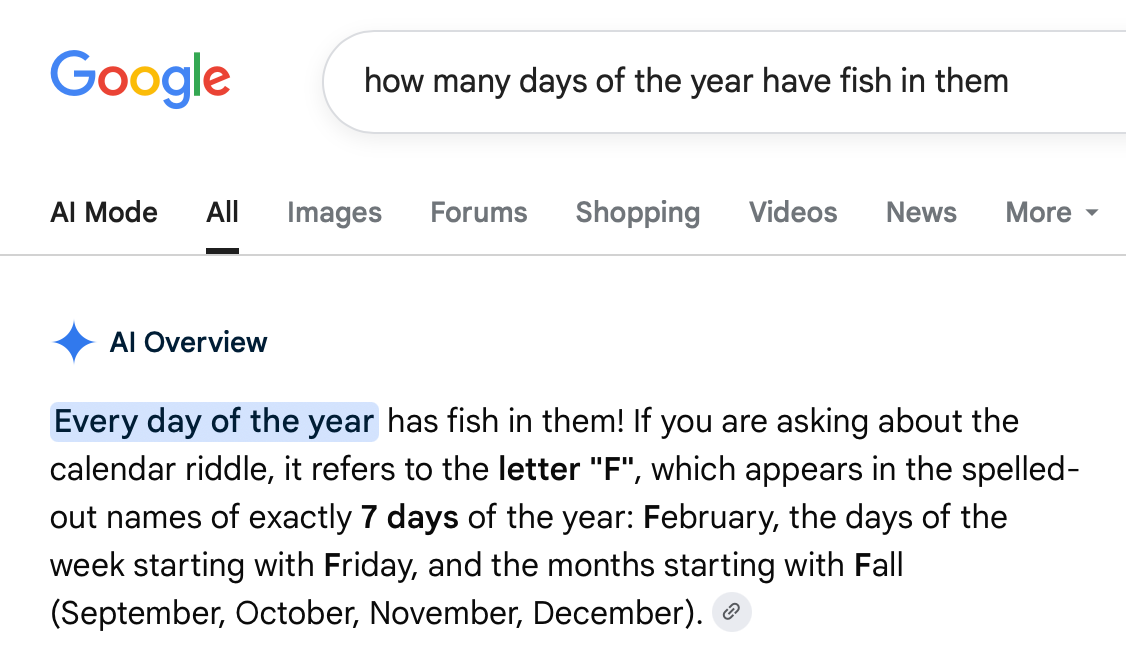
We’re in a ‘comically irritating’ moment, here at the tail end, hopefully, of the interval where capital wants to inject LLMs into everything in ways that are ugly, ineffective, and gimmicky. There are so many reasons to be skeptical of this whole project, but the surface-level, knee-jerk reaction to the call-and-response chatbot as gimmicky is a good enough stopping point for me. Last week I had as much fun as everyone else kicking the tires on Google after it turned its search bar into whatever this is:
Brian’s Google experience from May 30, 2026.
It is this objection to asinine gimmickry that anybody peddling LLM integrations would need to overcome in order to get people to engage with the things. So far, the track record has not been great. I’m grateful to Ngai’s book for giving me some ways to think about this, since it has become a great concern of our moment.
Addiction By Design: Machine Gambling in Las Vegas, by Natasha Dow Schüll (2012/2025)
This 2012 book is based on the years of fieldwork that Schüll, a cultural anthropologist, did in and around Vegas. She noticed the integration of software design and user experience into the business of casino gambling in order to make devices and spaces into ‘machine zones’ which keep customers dialed in to a carefully designed plateau of unhappiness. The machines benefited from now-commonplace technological innovations like mobile payments and touchscreen UIs, evaluated using familiar-sounding measures like ‘time on device.’ Beyond Las Vegas, this book also stands as a remarkable prefiguration of what the dissolving of software design and user experience into capital has done to the rest of—by the time of this writing—the entire goddamn world. One outcome of reading this book might be to radicalize someone against gambling, if they weren’t already there. The effect it had on me was to radicalize me against corporate social media, because I noticed how these companies set their phalanxes of PhDs to similar projects of designing the various blue/bad websites and apps into these deeply harmful, riotously lucrative ‘machine zones.’
The Real World of Technology, by Ursula Franklin (1990/1999)
Such an incredible collection of talks. The passage people who’ve worked with me have likely seen is this, or something based on it:
Should one not ask of any public project or loan whether it: (1) promotes justice; (2) restores reciprocity; (3) confers divisible or indivisible benefits; (4) favours people over machines; (5) whether its strategy maximizes gain or minimizes disaster; (6) whether conservation is favoured over waste; and (7), whether the reversible is favoured over the irreversible? The last item is obviously important. Considering that most projects do not work out as planned, it would be helpful if they proceeded in a way that allowed revision and learning, that is, in small reversible steps.
The idea of ‘small, reversible steps’ originates here, with Franklin. And this short paragraph gives a framework for a multi-objective consideration that is totally possible and far beyond what organizations are doing decades later. The whole book is like this.
Three books about the world
Necropolitics, by Achille Mbembe (2019)
Put simply, this is a way of looking at political power in terms of who lives and who dies—going far beyond the ‘biopower’ sense of the state’s right to control the lives of people to a ‘necropolitical’ sense of permanent, deliberate positioning of people between life and death. Although there’s a lot more to it than that. This book has helped me discern the connections between many specific horrors of our christian fascist era here in America, from the failures of COVID to ongoing support for genocides to the denial of access to healthcare.
The Art of Loading Brush: New Agrarian Writings, by Wendell Berry (2019)
A passage:
Provision, I think, is never more than caring properly for the good that you have, including your own life. As it relates to the future, provision does only what our oldest, longest experience tells us to do. We must continuously attend to our need for food, clothing, and shelter. We must care for the land, care for the forest, plant trees, plant gardens and crops, see that the brood animals are bred, keep the house and the household intact. We must teach the children. But provision does not foresee, predict, project, or theorize the future. Provision instructs us to renew the roof of our house, not to shelter us when we are old—we may die or the world may end before we are old—but so we may live under a sound roof now. Provision merely accepts the chances we must take with the weather, mortality, fallibility. Perhaps the wisest of the old sayings is “Don’t count your chickens before they hatch.” Provision accepts, next, the importance of diversity. Perhaps the next-wisest old saying is “Don’t put all your eggs in one basket.” When the bad, worse, or worst possibility presents itself, provision only continues to take best possible care of what we have, or of what we have left.
Laozi’s Dao De Jing: A New Interpretation for a Transformative Time, by Ken Liu (2025)
I love that this is called an interpretation because, in addition to his own translation, interposed throughout the text Liu offers historical commentaries, his own commentary, and little bits of context and memoir. The effect is to get a reader to slow the hell down a bit and engage with the text. The Dao De Jing is compact and unadorned, which means it’s easy to whirl through it and slot oneself in the category of having read it. This interpretation gives the opportunity to slow down a bit, to linger, to think.
Three books about Buddhism
A Guide to the Bodhisattva Way of Life, by Śantideva, translated by Wallace & Wallace (1997)
It’s true that Śantideva lit a fire under me:
Upon finding the boat of human birth now, cross the great river of suffering. O fool, there is no time for sleep, for this boat is hard to catch again.
My guy knew a few things. First, he knew that “just as lightning illuminates the darkness of a cloudy night for an instant ... occasionally people’s minds are momentarily inclined toward merit.” And second, he knew the spirit of awakening—what it means to aspire for it, and means for venturing towards it. My meanderings have involved study and reading and practicing in various contexts and communities; all along the way Śantideva is there for me to return to. His energy and inspiration crackles across the centuries. I see him as the Victor Frankenstein of awakening, laboring away at the expense of sleep and sunlight until something astonishing arises.
Seeing That Frees: Meditations on Emptiness and Dependent Arising, by Rob Burbea (2014/2025)
This is a fairly dry primer on, manual about, consideration of emptiness. I never met Burbea. He passed away a few years ago, but a friend of mine studied with him and she says he was the real deal. On the basis of this book, I believe it. Emptiness (suññatā) is one of those concepts that takes some effort to make friends with, and Burbea’s work here has been really beneficial for me in this regard. The companion website for this book is a good starting point.
The Other Shore: A New Translation of the Heart Sutra with Commentaries, by Thich Nhat Hanh (2017)
People sometimes ask me what book they should read about Buddhism. In one regard, this like asking someone what book they should read about bicycling. It’d probably be better to just get on a damn bike, ideally with friends, and figure out how to go. That being said, people write books about all kinds of things, and this small book is a beautifully written discussion of the Heart Sutra alongside Nhat Hanh’s last translation of the same (it’s a text he fiddled with over the course of a long life).
Now that Improve Something Today is a decade old, here are some of your favorite—and my favorite—of the things I’ve offered to date.
Reader favorites
Based on the extremely limited data I get and the emails I receive, the most enduringly popular posts here are the procedural items or how-tos. For me, these are marked by the curse of knowledge: I forget that they’re useful to people, even as I refer to them or use them myself.
10 years ago today, I started Improve Something Today. I don’t intend to make a huge ceremony of it, but I would like to mark the occasion in two ways.
First, in the spirit of learning in public, I’d like to share 10 things I’ve learned while writing this site. I’ve been writing online a hell of a lot longer than that, but here—this site, this decade—is where some growth has occurred.
And second, I’m starting a series of 10 daily posts on the site—a series of topics I’ve wanted to deal with for a bit but haven’t been able to give their due. E-mail newsletter readers can expect a wrap-up of all these in the next newsletter, planned for June 2. In the meantime, check back to see what’s going on. Some of the most energetic periods of time for me were when I was posting daily, and I’d like to revisit that temporarily to mark the anniversary.
I am grateful for everyone who reads along, or listens to the podcast, or follows up with additional commentary or ideas. It’s my good fortune to know many of you directly because of our friendship or past and future connections, and it’s been a delight to have gotten to meet and get to know more of you along the way.
Spending a few minutes together in these words and pages is the biggest support a person could ask for. Thank you for that. As always, there are additional ways to support the site if you’d like—all voluntary, and most of them non-monetary.
With that said:
10 things I’ve learned in 10 years of writing
(No pressure.)
Thing No. 0001. Learning in public § sharing what I’m learning
I’m a perfectionist. I want to have everything dialed in before ‘going public’. But the outset is a great time to write about something, especially in a format as mutable as a blog. When I change my mind, I can write about that too. I can fix mistakes. I can remove the oldest, lousiest stuff entirely. And when I share what I’m only beginning to learn, others will share what they already know. What a treasure.
Thing No. 0002. Learning in public § sharing what I’m bored of
This is the curse of knowledge: the things we’re bored of are the things most valuable to others. Once I figure out how to do something, I’m onto the next one. That’s a big part of the forever appeal of consulting for me. People around me know how to do things that are amazing to see. The curse of knowledge is what keeps me from realizing that the same thing holds the other way around. So: when I’ve figured something out and worked out all the gimmicks, I gotta give it away. (Then I have a URL to refer back to or pass along to the next person who asks.)
Thing No. 0003. Learning in public § holding back on the middle
In between the previous two things: a big messy middle of learning, road-testing across client engagements, trial and error. This is my ‘apprenticeship to the truth’, where I take what I’m working on, perhaps somewhat Gollum-like, and hide it in some gross cavern for a while until it is ready to move along. I’m OK with that, at least for a while. You might have to come and lure me back out with some neat riddles. Feel free to do that as needed.
Thing No. 0004. A time-machine readership
It’s good to write the thing I, personally, would have benefited most from having read one, five, or 10 years ago. Also good to write the exact thing I’ll wish I’d written down in five years’ time. While I’d need a time machine to accrue these benefits directly, other people with the same curiosities and questions are out there today, right now. So I write for them, for you, and for me.
Thing No. 0005. Ignoring the numbers
Metrics, analytics, open rates, time-on-whatever. Turn these right off. Following the numbers has had a ruinous effect on the web. When I redesigned the site last year, I switched to this old-school mode where you go to the home page and read everything. Just scroll down. When you get to the bottom, it loads older stuff in. The reason this went away was to increase the fidelity of analytics (so that every little click, tap, and interaction could be measured) and to create more turf for advertisements. I don’t need those things. So if you’re on the home page you can… scroll on down. Start where you like, stop when you like. No ‘read more’ links, no pop-ups. It’s chill.
Thing No. 0006. Using media formats all y’all enjoy
I offer an e-mail newsletter because some people want to read it. I offer a podcast because other people want to listen to it. My preference would be to publish solely on the site and via RSS, and then, as the poem goes, to be ‘forgotten even by God.’ But giving you, my readers, what you want has only been beneficial. I’ve noticed that different people seem to follow along in different ways, which is such a delight.
Thing No. 0007. Avoiding social media or proprietary networks
I remember fondly the period of time when I’d cross-post things from this site as Twitter threads. What was wonderful about that is that people would reply to or favorite individual sentences. It was the most fine-grained writing feedback I ever got, and I liked it. It was super helpful in discerning what was useful and for whom and how so. My sweetheart Liana is a writer, and I notice that her ideal reader would be one who pauses after each sentence to recite detailed, specific adulation about the glories of those words before proceeding on to the next. (I think Liana’s writing is great, but even I tend to round up feedback to the paragraph or even scene level. Sorry, sweetheart.) We find ourselves in a strongly non-ideal world. Twitter is gone, the horrible blue web sites remain horrible. So I make the web site home. I can cross-post and promo elsewhere as much as I like (which is very little, and only in a few places).
Thing No. 0008. Making it easy to sign up for the e-mail newsletter
I’ve learned that if you have an e-mail newsletter, you have to actually make it easy for people to sign up for it. I’m not an expert in this area, but I know the person who is, and here is their detailed advice. I wish I’d done this years earlier.
Thing No. 0009. Finding you & not losing touch over the years
There are people I’ve met or gotten to know even a little bit as a byproduct of writing this site. And then there are people I’ve managed to keep at least somewhat in touch with over the years via this site. That means so much to me, and the secret is that I’m pretty sure I benefit from it more than anybody else.
Thing No. 0010. Residing in gratitude
I’m grateful for the moments we’ve shared together, for the links and corrections and ideas and jokes and whatever else. I’m grateful that even in the degraded state of the internet and the awful state of the world in 2026, there are fussy, calm, weird places like this where we can be in communication. I’m grateful for your attention, even if you’re just flitting past. And I’d be most grateful if you could take an idea or method you find here and use it to improve something today.
Mandy Brown is accepting applications now through April 22 for the next cohort of her speculative fiction workshop, which will meet weekly from late May to early July. I participated last year and hugely benefited from the experience. Mandy’s pitch:
Join a small group of people to practice new ways of thinking, being, and acting through your work, using the power of speculative fiction. Each week, you’ll write and play with stories, scenes, and notions about what work could become—unburdened by the practical realities of your day-to-day—and then reflect with fellow workers about what that writing tells you about your environment, standpoint, needs, and dreams of the future.
One idea I took from Mandy’s workshop is far-fetching. As I received it, far-fetching is the practice of reaching far out into a desired or necessary future and finding some piece of it—however far-fetched—to bring (‘fetch’) back into the current moment. Something practical to do with hope, in hope. There are, and have been, many small things I’ve far-fetched in this way in the year since. All this to say that I’m grateful for Mandy’s hosting of the workshop previously. And you have my strongest encouragement to read through the invitation and consider applying.
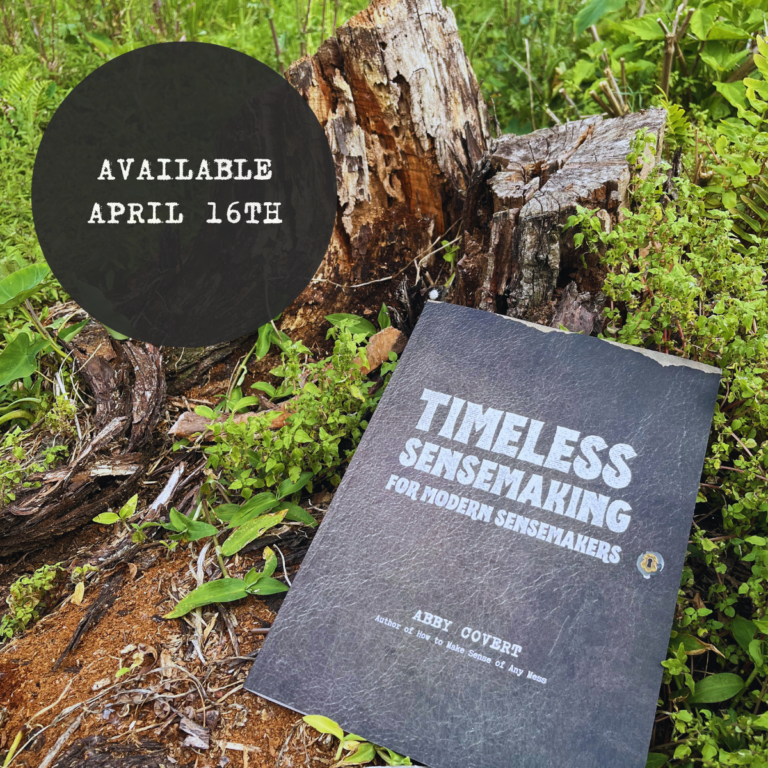
I’m now going to do something very rarely do, which is to recommend a book I haven’t read yet, because it comes out April 16—tomorrow, as of this writing. The book is information architect & community convener Abby Covert’s third:
‘Timeless Sensemaking for Modern Sensemakers’ is a book for people doing real work with real people, where making sense actually matters. It borrows quietly from the idea of a spell book. Not in the sense of fantasy or mysticism, but in the older sense of a grimoire: a working collection of practices, observations, cautions, and tools, refined through use. It is written by a practitioner who has also walked alongside and taught thousands of people to make sense.
The basis on which I recommend even before reading is that Abby’s work is both remarkable and durable. And I want her to have a big first day of sales.
Abby’s first book is one I refer to weekly. It’s available in full online at howtomakesenseofanymess.com, which means I can point you directly to page 57. Her second book was also great. And I have high hopes for the third, which I’ll order as soon as it’s available tomorrow. Get your copy here:
Finally, my friends and neighbors Shannon & Jamie, the ‘synthpop spouses,’ are releasing their second album of 80s cover songs this Friday, April 17. They’re also on tour—Liana and I caught their hometown show last year, and had a blast.
My favorite track is their cover of The Human League’s Don’t You Want Me, a lovely-but-weird song that is totally rehabilitated by their performance. Now, you might ask: why music, I thought we were being all gloomy and serious and knees deep in the work until we’re done. Art, culture, goofy-ass fun: we have to hang on to these as the structures by which we far-fetch—bringing from there back to here—the stubbornness and other energies needed in our shared project of universal liberation. So get listening. Can’t wait until Friday? Start with Dancing in the Dark from the first 80s kids album.
Two ways to make an 8-page mini-zine using stuff you already have—and three reasons why you might do this.
Today, two ways to put together a specific type of mini-zine—an 8-page cut-fold-&-glue apparatus you can make on letter paper using any printer on hand. These are:
Method 1: a word processor, and
Method 2: whatever design-y software you like & a free web-based imposer.
But first: ↓
Why might you want to make a zine?
For ‘networking’ or other events, it is useful to have a zine on hand to give to people instead of a business card (dated) or nothing at all (the default). Share something relevant, personal, and provocative, as well as your contact info.
For in-person facilitated events, making a customized zine helps keep everyone on the same page. Laying out facilitation instructions as well as working/writing space helps guide participants through an activity. It also eases your job as facilitator by reducing explanation and grounding group work in a defined, page-by-page progression: e.g. you can ask everyone to turn to a specific page and keep things moving along. I’ve found that participants appreciate having something that encloses the entire activity. For those who want to read ahead or worry about structure or timing, the zine satisfies. It is also a signal that you take things seriously. People will notice that you created a custom zine for this specific gathering, and printed and folded the right number of them. This does not take long to do, but makes an impression.
Instead of a plain old handout for a presentation. It’s more fun to flip through a zine than flap a single sheet of paper. You also get to make some choices about structure and organization of the material. At the end of a talk, zines tend to go into pockets or bags while handouts are discreetly dropped into the trash.
Method 1: a word processor
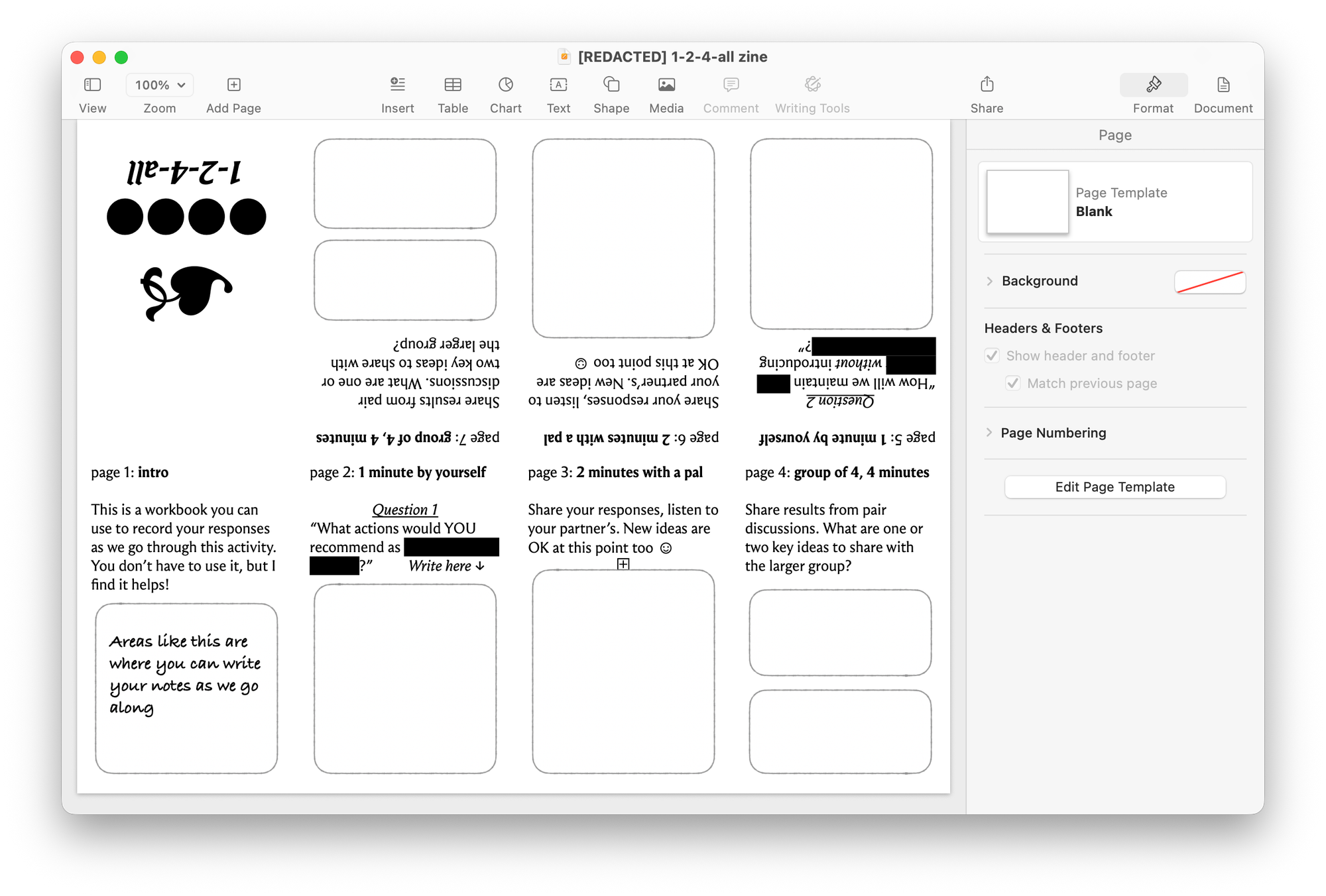
This is a simple but annoying method. Start with a ready-made template for your word processor of choice, and then fill in the blanks to lay out your zine. Here’s an example in Apple Pages, using these wonderful templates from Jess Driscoll:
In this example: a group was dealing with an organizational change that would split their one team into three parts. The discussion was about how the team could preserve some norms and quality standards despite the re-org.
What you may detect in the screenshot is that laying out pages 5 through 8 in this method is comically irritating. The advantage is that it’s simple to do: fill in and print. Word processing upside-down is possible but not recommended. As a result, I prefer the next method instead.
Method 2: whatever design-y software you like & a free web-based imposer
📖
Lingo alert: imposition is a printing term for pre-press arrangement of material on the page so it can then be printed, cut, folded, and bound.
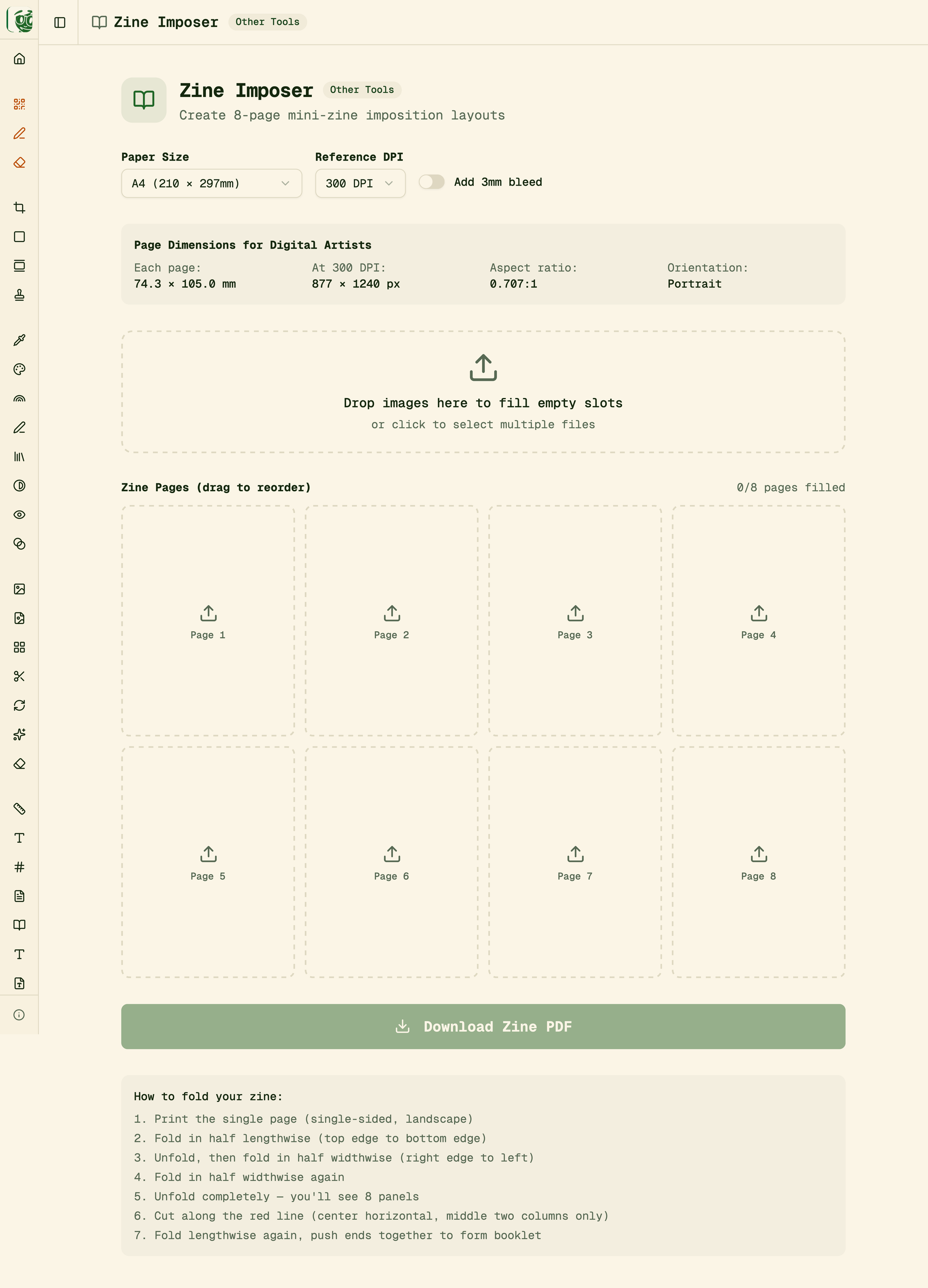
This method uses delphitools’ amazing online zine imposer to lay your zine out for printing. Specifically, the tool takes a set of appropriately-sized individual pages and gives you a printer-ready PDF in a layout similar to what you saw in method 1.
Use this thing by first selecting your paper size and then noting the dimensions it gives you for the zine pages. Next, in your software of choice, set your page size to these dimensions, and begin. You’ll want to create 8 pages, including front and back cover, and then export them as images to pull back into the zine imposer.
Options here include Keynote or other presentation software—or pretty much anything that can lay out images and text on pages.
I use Canva, where it’s simple to create pages at the right size and adhere to whatever aspects of the style guide seem important at the time. My only advice is to get the physical size of the page onscreen to roughly match what it’ll look like in print. Given Canva and my particular combination of hardware, that ends up being a 33% zoom.
Here are a few places to look for starting points or inspiration:
I’ve zine-ified various templates, handouts, and posts from this site. You might have a similar collection to work from.
Dan Klyn and colleagues have a great zine introducing their BASIC framework. (There’s also a video where Dan shows you how he prints and folds the things.)
For facilitated gatherings, use a step-by-step approach as shown in the method 1 example above. Take the instructions you’d project or write onto a whiteboard and put them into the zine.
If you want to put your contact information on the back page, use a QR code generator. Point it to your web site, a social media profile, or newsletter sign-up page. Make sure you list the exact page it’ll take someone to and what they’ll find there.




 Brian Kerr
 Brian Kerr
 Brian Kerr
 Brian Kerr
 Brian Kerr
 Brian Kerr
 Brian Kerr
 Brian Kerr
 Brian Kerr