Skip to Content

Improve Something Today

Posts on page 6

4 favorite Liberating Structures for continuous improvement

Weird flowering moss on an very old wooden shed.
Photo by Brian Kerr.

Getting specific about facilitation methods & how to incorporate them into the work.

I’ve previously shared an introduction to Liberating Structures, the methods that filled the “facilitation gap” in my own continuous improvement practice. These 4 Liberating Structures have been most important to my continuous improvement practice.

During planning

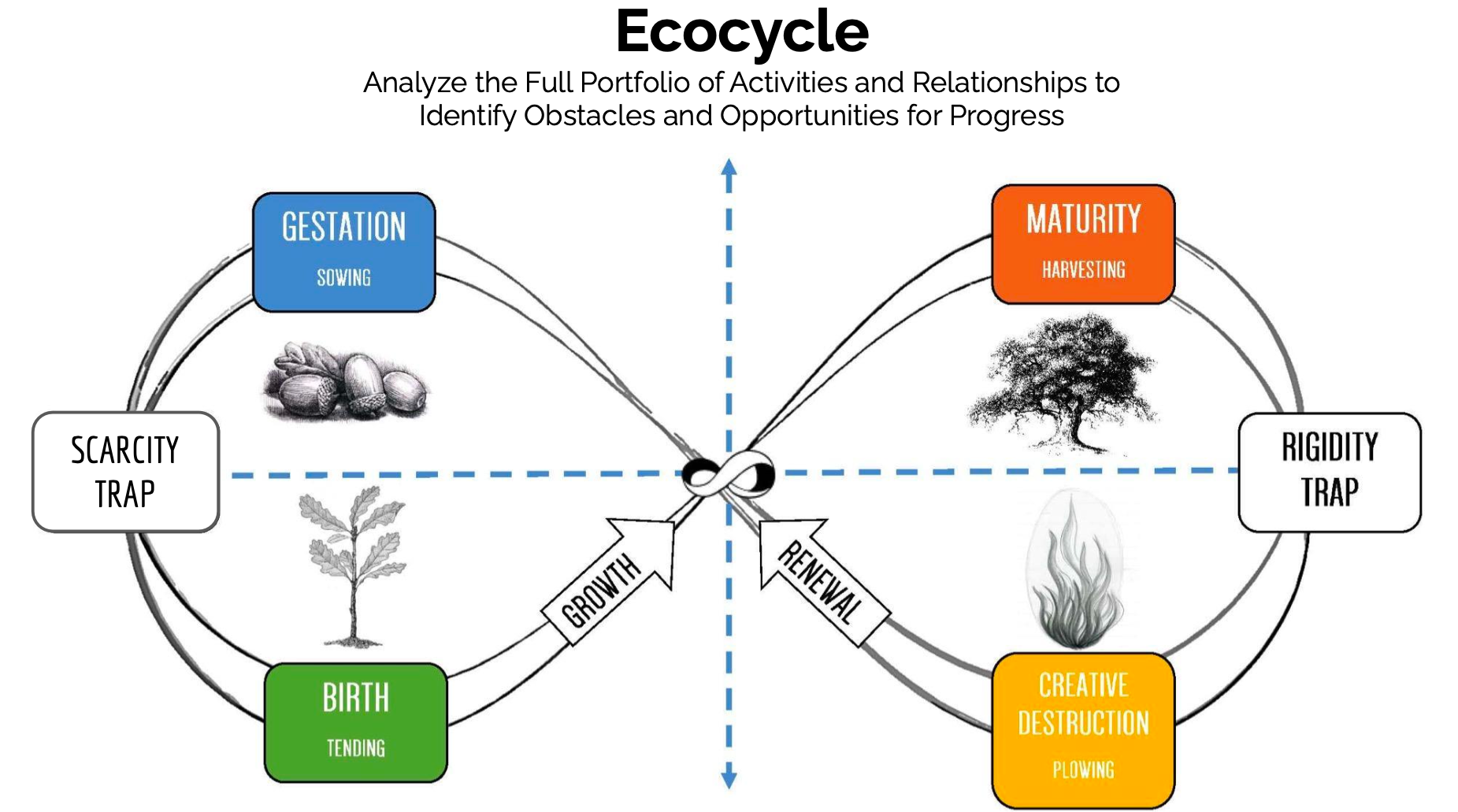
  • Ecocycle Planning—an initial conversation that can help an uncertain or newly formed team figure out what to work on. Starting with a portfolio-level listing of major systems or responsibilities, people locate each of those in its overall lifecycle. The resulting ‘ecocycle’ is a big picture of things that need fixing, things that could be skillfully closed down, and things that need to be nurtured into further growth. There’s your schedule of continuous improvement projects.

During an improvement activity

  • TRIZ—a scavenger hunt for existing system behaviors that produce bad outcomes. Purposefully designing a broken system is fun. Then, insight comes when people look for similarities between the bad system they’ve imagined and the way things get done today. TRIZ lets groups see how their collective work is both interrelated and necessary—and where there is room for creative destruction.
  • 25/10 Crowdsourcing—a machine for generating bravery, starting with the question: “If you were ten times bolder, what big idea would you recommend?” The activity ends with a tantalizing presentation of the weirdest ideas that were elevated or supported by the whole group. There will be a few ideas you can go do right away, ‘ten times bolder’ premise be damned.

Afterwards

  • What/So What/Now What—a group closing reflection and commitment. Can scale up or down, but this is the smallest possible closing that helps people make sense of what happened and to decide what’s next.

Look, they’re all good

There are dozens of Liberating Structures. Even if you are familiar with some of them, others will be new. I encourage you to seek them out. For example, I only started using Ecocycle Planning in the last year or so, but it has already gotten me out of a couple real pickles.

November 14, 2024: Edited for length.
Featured

The world of silence: marking Disability Pride Month

The world of silence: marking Disability Pride Month
Disability Pride Flag by Ann Magill.

Being a hearing-impaired person whose job is to listen. Quiet, noise & rest.

Quiet isn’t. Here’s what I mean:

You write sitting in the back garden, where the barest breeze is enough to rustle the limbs and leaves of the fruit trees, to raise a little hiss from the tall grasses, and to awake a larger, fuller breathing from all the trees beyond. You hear the chittering of birds jockeying for position at the feeder, or the occasional squabble of gulls or crows. A fence gate clacks, a vehicle revs, an airplane passes low on its return to base. You hear the sound of your fingers hitting keys on the keyboard, even though you use the quietest keyboard money can buy. You hear your breathing and the rustling of your linen shirt. You hear your teeth grinding, which is how you know you’re lost in thought.

That’s quiet. It’s active, it’s noisy, it never stops. Even in a perfectly still, empty house there is an ongoing tumble of things to hear.

But—there’s something else entirely. Take out your hearing aids, set them aside. So much drops away. The breeze becomes a pattern of pressure and temperature on your skin, in your hair. This is the real silence, the silence that opens up once you shut down all the hissing, buzzing quiet. For a little while, you don’t have to worry about how much work it is to listen to people. You don’t have to adjust position, posture, device settings at the beginning and end of every single conversation, forever. You can unhook the 20% of your awareness that is held to listen for voices, always standing by to begin the energetic work of listening.

Being tired

I am usually tired after a day of work—especially onsite—because listening to people is hard.

  • On the one hand, I love listening to people, because people are interesting, and listening is one of the best ways to learn about them (the other best way is watching). And my whole thingy of reducing suffering and wasted effort across an organization depends on getting people to speak with one another.
  • On the other hand, listening to speech is something that so far as I can tell comes easily to most people, but is a lot of effort for me. Reading is easy. Listening is hard. That’s just the way it is.

Being lucky

I’m lucky that I was born where and when I was, and to be part of a supportive family with resources. I started using assistive technology when I was a toddler. The pile accumulates and updates as I age: fewer knobs, more touch-screens. My first hearing aids were unlovely wasp-like devices to catch and boost sound in delicate little curves mirror-matched to my hearing loss. Machines for converting an expensive, wasteful heap of disposable batteries into speech, music, the clatter of life. Over the decades the hearing aids have become accessories to everything else—to the car, to the computer, to the iPad. My iPhone doubles as a discreet little roving mic to pick up what you’re saying in that noisy cafe. You put your phone on the table for whatever reason. I put my phone on the table to hear what you say.

Being a talking animal

As a child I read Carl Sagan’s “Cosmos”:

We are the local embodiment of a Cosmos grown to self-awareness. We have begun to contemplate our origins: starstuff pondering the stars; organized assemblages of ten billion billion billion atoms considering the evolution of atoms; tracing the long journey by which, here at least, consciousness arose. Our loyalties are to the species and the planet. We speak for Earth. Our obligation to survive is owed not just to ourselves but also to that Cosmos, ancient and vast, from which we spring.

I read Albert Camus’ “The Myth of Sisyphus”:

At this point of his effort man stands face to face with the irrational. He feels within him his longing for happiness and for reason. The absurd is born of this confrontation between the human need and the unreasonable silence of the world. This must not be forgotten. This must be clung to because the whole consequence of a life can depend on it.

For most of my life, I thought this was the project: to obliterate the silence of the world, offensive in its mere presence, by filling it up with speech, and to use speech to do good things. To speak for the earth, since (after Rorty) the world does not speak, only we do.

Being comfortable

In 2022, I sat a silent meditation retreat for a week, my first time practicing at that duration and intensity. It was an important experience, and I also complained about it a lot. The first day or two or three I really struggled as I found myself alone in our very quiet family cabin. The longer I sat the more noisy and rattly it all became. At a certain point I pulled out my hearing aids and that made all the difference. I could rest.

The silence I expend so much effort and money to dispel became exactly what I now wanted to sit with. I couldn’t hear the daily chants or the heart sutra with my friends in the Zoom sangha, but that was OK—I knew what we were saying. On that retreat I realized how much work I put into listening, even when there is no need to hear, or nothing to listen for. That silence produced stillness, and in sitting I fell away from the logics of attainment and progression that had haunted me for decades (and still do).

I used to get deeply unhappy or funky when I couldn’t wear my hearing aids for whatever reason. But these days—here’s my secret—the instant I am alone, out they go. I want the world to be safe and lovely and a place of liberation and flourishing for everybody, and I feel somehow closest to that world when I am in the world of silence. I also want to sit and talk with people and listen to them all day every day—to chat ceaselessly with my friends, to gossip with everyone at work, to learn what my past clients are up to, to listen to one child give an artist’s statement for his most recent tongue-preserver-and-colored-pencil apparatus, or to, at nighttime, listen to the other child practice his violin, or to Liana singing and playing guitar.

They say the body is a city with nine gates.

Two of mine happen to be a little finicky.

I truly believe that if I could begin again at life with a body that could hear better, or more typically, I wouldn’t go for it. While I might have an easier time and have fewer large out-of-pocket expenditures, I just don’t know what it’d be like to live in the world of hearing. It’s a wonderful place to visit. But the world of silence is where I began and where, I think, I will end. It’s the underlying fact of my life. And I have a good life; I do good work.

It’s on that basis I embrace disability, and my disability, and—this month—disability pride.


Happy birthday to the ADA.


July 2, 2025: Edited to add the following dismal 2025 coda. ↓

Dismal 2025 coda

As I revisit this piece from 2023, I stand by everything in it.

But a few updates are in order:

  • In 2024 I was lucky enough to do another week-length silent retreat and reconnected with that deep silence. I am so grateful for that experience.
  • Just last month, in June 2025, I paid cash out of pocket for newer, fancier hearing aids. Rule-making by Joe Biden’s FDA increased the range of options available to me and dramatically decreased my costs.
  • And as I write these words on July 2, 2025, Republicans in the US Congress are scrounging together the remaining votes they need to pass the ‘big beautiful bill’ containing (in addition to every other awful thing) numerous specific attacks on services, protections, and basic health care for people with disabilities. This is a particularly intense moment in that regard. But today, this week, this season, is also part of their larger, ongoing project of excluding, denationalizing, and dehumanizing anybody that doesn’t fit into their specifically chicken-hearted, incoherent Christian Nationalist nightmare vision. It is in this context that we celebrate Disability Pride Month this year.

Using Liberating Structures to facilitate continuous improvement

Using Liberating Structures to facilitate continuous improvement
Photo by Brian Kerr.

You’ve gathered everyone together around a problem. Now what?

“Five conventional structures guide the way we organize routine interactions and how groups work together: presentations, managed discussions, open discussions, status reports and brainstorm sessions. Liberating Structures add 33 more options to the big five conventional approaches.”

So much of continuous improvement comes down to gathering a small group of people together (ideally with snacks) and opening a space so that everybody can decide what to do next.

The Lean books and teachers I learned from taught me what needed to happen—the observations, diagrams, analysis, ideas, and plans—but couldn’t convey how to get all this to occur within groups of people who were happy, unhappy, skeptical, annoyed, burned-out, eager, curious, tired, distracted, in pain, lost in thought, worried, hungry, or optimistic.

Facilitation is its own separate skill.

Like the other so-called “soft skills,” it is hard as hell.

But eventually, Liberating Structures gave me the methods I needed.

No new thing under the sun

Each Liberating Structure is a recipe for a small, generative group interaction. Flip through the collection and you’ll find short definitions and plenty of examples, along with detailed, insightful facilitation guides.

As you explore, many of the formats and activities might seem familiar—and for good reason. Very little of this work is original, which is why nearly all of it is useful. For example, the What, So What, Now What? Liberating Structure is one particular expression of a device you might have seen in academic or business writing (as Chris Argyris’ ladder of inference) or in community development (my teachers at the Institute of Cultural Affairs call it ORID, an unlovely contraction of “objective, reflective, interpretive, and decisional”). The point of this particular Liberating Structure isn’t to be innovative, but instead to give just enough structure to help a group to listen and reflect on its shared experience. And it, like all the others, is offered with attribution and links to further reading to satisfy the eggheads.

Most of the Liberating Structures are small, with time commitments beginning at around 15 minutes. As you practice them, you may find yourself planning events by chaining a sequence of Liberating Structures together. There’s even a Liberating Structure for having group plan its own event—what my friend Dan calls choreography, but the Liberating Structure is called Design Storyboards.

And Liberating Structures are a great boost to continuous improvement efforts because they loosen up hierarchies and create new ways for people to learn from one another. This is an important part of Lean, and it’ll happen eventually—but some carefully deployed Liberating Structures can help things along. Some of the structures, like Ecocycle Planning, fit directly into the portfolio planning and management systems that sustain continuous improvement over time.

Getting started

The stuff is available online and is free to use. Read up on the Liberating Structures web site, starting with the LS Menu.

I recommend the excellent, free LiSA app for your phone or iPad. (LiSA also runs on recent Macs.) LiSA is great for quick reference, as well as for working out an agenda using a chain of Liberating Structures.

Beyond that, the very best way to learn Liberating Structures is to watch, do, and teach. (It’s also the best way to learn anything.) For this purpose, my friend Alyssa recommends this monthly international, online meetup.

Big changes, small changes

It’s only fair to let the Liberating Structures folks have the last word. Because what they want is what I want, too:

“We want everyone to learn to foster big changes by inviting people to make small structural changes in how they work together.”

23 reasons to write online

23 reasons to write online
Photo by Liana Kerr.

Write to dispel the curse of knowledge, to find your people & to become.

People write for lots of reasons: To become famous. To make money. To sell. To connect. To join. To have written. To create social proof. To influence. To communicate. To make a world. To right a wrong. To increase the n. Because everybody else is doing it. Because someone else said they should do it.

Today, 23 reasons I think you should consider writing online. Pick one reason, pick them all, make them your own.

Reasons

  1. To allow a small number of as-yet-unknown, possibly very consequential people to feel as though they’ve gotten to know you a bit, before you ever speak. (I’m a consultant. 3 out of 4 interviews I have with prospective clients involve them bringing up something they read or listened to from this web site. I enjoy that.)
  2. To make your first conversations with certain new friends immediately engaging and specific, since they will have already apprehended your bullshit and felt there was something there.
  3. To disqualify people who don’t vibe with what you are up to. They will glance off the edge of your atmosphere and float somewhere else.
  4. To sort things out, to somehow make sense of an absurd world, and cram the results into enough of a structure that it becomes hopefully intelligible to at least one other person.
  5. To dispel the curse of knowledge. You know much more about certain things than most people, and your life experiences mean those things have become connected—intertwingled?—in contingent, weird, productive ways.
  6. To dispel the curse of knowledge. You probably don’t realize how much you know about the stuff you know about. Lay it all out on a page and, goddamnit, turns out you know a lot. That in itself is good to know.
  7. To dispel the curse of knowledge. Here is a super powerful capability: to be able to borrow the perspective of someone who doesn’t know the same things as you do, and support them as they develop their own expertise.
  8. To get clear about the language you want to use. And I don’t mean cussing (you must swear at least a bit in your writing so people will know they are dealing with a human being and not some tediously apologetic autocomplete LLM). I mean knowing what things you are thinking about, and what you would like to call each of them.
  9. To identify your lil’ shortcuts, jargons, and irritants.
    (For me, these include the words “just” and “here.”)
  10. To find out where you are wrong.
  11. To find out where you are right.
  12. To eventually give each idea its own URL, which is cool.
  13. To take these ideas—now having their own URLs—and e-mail them to those who want to read by email, publish in an RSS feed for those who want to read by feeds, and the like.
  14. To maybe even circulate these URLs across the various algorithmic hellscapes (LinkedIn, Twitter, etc.), giving people something to glance at between the advertisements. Your items are errant kibble in the feed, but you can automate the postings and just—see #9—let the machine operate.
  15. To locate the people who are your people. Bring them in, wherever they are. One person a month is fine. This is the real deal.
  16. To have a very slow conversation with a friend over the span of months or years.
  17. To accumulate a “swipe file” you can borrow from when called upon to present, speak, convince, design, etc.
  18. To draft a book, one page at a time, with the garage door up.
  19. To create the conditions for eventually revisiting your old stuff and noticing with horror how your thinking has changed over time.
  20. To get other people to tell you what to read next: this link, this article, this book. You’ll always have a backlog.
  21. To learn.
  22. To practice.
  23. To figure out who you are, so you can become that person.

The jewel of resistance

The jewel of resistance
Photo by Brian Kerr.

Resistance to change is precious. Here’s how to make the most of it.

When planning a change in the workplace, the topic of resistance always comes up. And when it does, it seems bad—resistance as debris to be cleared away or routed around.

In this way, labelling people “resistant” is a complaint without recommendation. It’s a wish that things were other than they are.

Resistance prioritizes the wannabe change-maker over the people being asked to change.

Resistance is not a problem. It’s a signal

People who resist a change are telling you:

  • They care about something. What are they afraid of losing? Someone in this state might not be able to articulate their worry. So draw pictures, make models. Once a shared explanation arises, frustration disappears.
  • You’ve overlooked something. Find the details you’ve missed. Are people burned out after many botched changes? If so, take special care.
  • They are your future champions. Convince them of the value of the change and they’ll support it wholeheartedly.

The purpose of resistance

Consider this, from Sara Fine’s 1986 study of how librarians resist change:

“Resistance will always exist, … acceptance of a current innovation is no assurance that the next level of change won’t be resisted, perhaps even more vigorously, as people make commitments to what they have achieved and mastered […]. Perhaps the purpose of resistance is to give us pause, force us to slow down, and impel us to pay attention to our basic human needs and values.”
April 15, 2024: edited for length.

On doing more with less

On doing more with less
Photo by Brian Kerr.

More what? Less what? 90 years ago, Bucky Fuller gave his answer. There is a different one now.

2023 is the year of economic headwinds, of the “soft macro,” and the return of an old, wet noodle of a rallying cry:

“We have to do more with less!”

This cliché keeps coming around. I first heard it at my first job after college, where it was issued as a resource for bravery, an utterance that utterly backfired. In the decades since, I keep hearing it.

Each time, something about the phrase makes me want to fill in the blanks—“Do more (of what?) with less (of what?).”

As far as I can tell, the general usage seems to be:

  • Doing more of this Making money for the company
  • With less of this → People

OK, that sucks! But first, wanna know where the slogan came from?

Bucky Fuller’s “ephemeralization”

Back in the 1930s, Fuller coined ephemeralization—which he defined as the capability of technological advancement to do “more and more with less and less until eventually you can do everything with nothing.”

Here it is, on page 279 of Fuller’s Nine Chains to the Moon (1938):

A paragraph excerpted from "Nine Chains to the Moon": "A corollary to the ephemeralizing-toward-pure-energy progression that is taking place throughout all science, and, ensuingly, throughout industry—which simply translates science into bread and butter for people—is that the more abstract the means of accomplishment the more specific the results: Efficiency == doing more with less. Therefore EFFICIENCY EPHEMERALIZES."

If you are not fluent in Fullerese, please skip hundreds of pages of turgid reading and know that in his framework “doing more with less” entailed:

  • Doing more of these things → Curing disease; eliminating infant mortality; providing housing and food for every family on Earth; and increasing the standard of living—and the freedom available for science, for art, for play, for leisure—with no upper limit
  • With less of these things → Time, space, and energy

What I wonder is… how’d we get from all that—from the translation of “science into bread and butter for people”—to the current jargon, where it means nothing other than “do the work of five people but with 3, even though our company already sheds cash like a housecat made out of money.”

In the 2023 “soft macro” condition of “doing more with less,” the mechanism by which people are meant to actually accomplish this lessening is deliberately undefined. It’s the same old management-by-objective horseshit: “more with less,” but with no material or managerial support, an effort totally unlinked from the value chain.

From five to three—but what of the two?

In lean management, there’s an answer for what to do when people come up with improvements—even improvements so effective that they take the work of 5 people and turn it into the work of three. There has to be an answer, because as soon as an organization starts a serious practice of continuous improvement, it will find improvements like that. Always. Opportunities are just lying around, and the methods will uncover them.

Anyways, the lean management answer is this: OK, three people will now do that work previously done by 5, in a way that is safer, faster, more reliable. This frees up the remaining two to go do something else within the organization. Maybe it’s helping another group get ahead, or helping peers learn continuous improvement. Maybe it’s starting a new project. Nobody loses their job. Nobody is catapulted to the next stage of their career via layoff. And all this gets accomplished in a way that everybody can see the changes in quality, cost, and safety.

It’s critical that management believe in this answer, communicate it effectively, and stick to it over time.

Why? Because that’s what moves an organization:

  • from the (bad) condition where people worry about working themselves out of a job, or observe that they will be punished and/or ignored for noticing problems at the workplace…
  • to the (good) condition where people become deeply engaged in noticing problems and designing improvements to their own work.

It may not be Bucky’s Utopian, humanist vision of translating “science into bread and butter for people,” but it does mean helping people get the work done on time, with less hassle, and respecting the wisdom and capabilities of everybody involved. And… at least for now, you know, I’ll take it.

June 13, 2024: Edited for length.