Skip to Content

Improve Something Today

Posts on page 3

Monthly links & notes for December 2024

Tide coming in on a cold December afternoon.
Photo by Brian Kerr.

The year’s end. Six amazing things my friends did. An activity for reflection & planning. Farewell to my waders & to the year.

My accomplished, wonderful pals

2024 was difficult—but ultimately very good—for me. Something that got me through the difficult parts was enjoying the successes of my friends, pals, and comrades, of which I offer an incomplete list here, in roughly chronological order:

  • The boffins over at Fenwick released the Think Like a Writer course, which I have taken and personally recommend. Most online courses are bad. Not this one. Instead, it’s a three-week commitment that produces immediate, durable results. (I wrote about this in May).
  • Lissy launched her playful learning company, HuMindWise, “turning burnout, stress, and imposter syndrome into opportunities for growth through game based learning and community.”
  • Devon completed and published her book project: The Accessibility Operations Guidebook. (My notes from October.)
  • A bunch of my friends rafted the Grand Canyon on the Colorado River. No names and no URLs to share, but everything about that adventure astonished and inspired me.
  • Shannon and Jamie completed their 80’s Kids cover album, which you can stream now, and which they’re taking on the road next year. My favorite track is the Boss’s Dancing in the Dark; play it really loud.
  • Over the summer and fall, Neetal released a set of 4 children’s books in her Pineapple Friends series of social impact books for kids. These passed muster with my seven-year-old child—so they’re the real deal.

On the site in 2024

I only shared one new blog post this year. I did manage to keep up with monthly links & notes, and did a bunch of cleanup—tidying older posts, organizing the junk drawer, and so forth. Everything about this was good, but I’d like to do more soon.

A format for year-end reflection

Greg and Brett at Same Team Partners created a simple, free activity called Replay and Reset for 2025. I worked through this over the weekend—in under an hour—and uncovered a couple ah-has as well as committed to some new to-dos for the new year. I encourage you to try this for yourself.

The bit about my waders

I hope you find some time to say farewell to 2024 and get your waders on for 2025. The water is rising fast and looking pretty choppy.

🐀
I must mention that the waders I use got eaten by rats this summer. I truly wish this was only a figure of speech.

I leave you with this, from §67 of the Tao Te Ching, in Stephen Mitchell’s translation. It’s as good an answer as any to the question of how we are meant to proceed from here.

I have just three things to teach:

simplicity, patience, compassion. 

These three are your greatest treasures. 

Simple in actions and in thoughts, 

you return to the source of being. 

Patient with both friends and enemies, 

you accord with the way things are.

Compassionate toward yourself,

you reconcile all beings in the world.

Monthly links & notes for November 2024

Monthly links & notes for November 2024
Photo by Brian Kerr.

A talk on values at work. The Multisolving book, which I think you should read. Whole-heartedness.

Online reading

“I feel connected to my organization’s culture.” Only 40% of leadership, 23% of management, and 19% of staff agree with this statement.

My pal Jenny Zhang recently gave a superb conference talk on ways it might be more useful to think about values (fit/mismatch/tension) in the workplace, instead of culture.

I particularly enjoyed this:

The expected return of going to leadership with negative feedback is terrible. Risk alienating your boss for the sake of telling the truth? Why? Even if you’re not directly retaliated against, and people often are, it can still really damage your standing. If you speak up too often, you’re branded as the naysayer. If you’re part of a marginalized group raising issues about how marginalized people are treated, you’re tarred as being “political” or “biased”. And of course, most of the time the canaries in the cultural coal mine are the marginalized employees with the least standing, because they’re the ones with the least protection when the cracks start to show.

Part of my client work is to get emerging leaders to develop systems for:

  • hearing bad feedback and
  • actually doing some damned thing about it—
  • even when the doing is difficult.

An important predicate here is that leaders must realize that by the time one person is willing to speak up about a problem, they typically speak for a scared-as-shit coalition of their peers. And, as Jenny points out, leaders should understand that the people who have the capability and urgency to speak up first tend to be the least protected.

Please, read Jenny’s talk or watch the recording:

the values of work
In October I gave a talk at Monktoberfest in Portland, Maine, a small and intimate tech conference with a big impact in the industry. It’s quite unlike any other conference I’ve been to, which is explicitly the point. I’d been hearing about the conference from friends for years, and it somehow still managed to exceed all my lofty expectations. Monktoberfest asks that your talk be something you wouldn’t be able to hear at any other conference. Mine was about values and how they show up at work and what happens when there is a gap between your stated and enacted values. It’s a theme that percolates through a lot of my writing and something I’ve spent many sleepless nights ruminating on, and giving this talk to such a receptive, empathetic, and compassionate audience was incredibly meaningful to me. You can watch the talk here: Seeing as I am personally allergic to watching any YouTube videos longer than five minutes unless I absolutely have to, I’ve also included a lightly edited version of the text of the talk below.

The “Multisolving” Book

I think this book by Elizabeth Sawin, just released, is an instant classic in systems thinking. The approach:

While the idea of killing two birds with one stone (or “filling two needs with one deed”) is age-old, and the notion of co-benefits in policy-making has been around for years, Multisolving addresses the current mismatch between complex, deeply intertwined societal issues and our siloed approach to them.

Systems thinking is vital for so many kinds of work, but it can also be easy to encounter it and come away thinking—that’s neat, but all a little theoretical, and I have these specific things I am trying to get done this week. This book builds on systems thinking from Donella Meadows and others, but organizes it all in a direct, useful way. Each chapter ends with two things:

  • First, some questions for reflection that I am finding useful, both for myself and to bring into discussions with others.
  • And second—this is a really wonderful surprise—a short poem that crystallizes the point of the chapter. I remember the images from these poems better than I do the content of the text (which is a good thing).

Buy a copy at the link below and use the code MULTI for a 20% discount.

Multisolving Book - Multisolving Institute
MULTISOLVING: Creating Systems Change in a Fractured World Order the Book Synopsis For most of Elizabeth Sawin’s career, she was not a multisolver. Instead, she worked on a single, albeit immensely important problem: climate change. Despite tremendous effort—long hours of teaching, attending conferences, publicizing analysis—at the end of the day, she felt like she was […]

Whole-heartedness

A theme for the month of Zen readings and week of silent retreat I did back in October was “whole-heartedness”—which I cannot think of as anything but the opposite of half-assedness. Here in the USA, we’re entering a season of the politics of the very worst. Achille Mbembe’s 2019 “Necropolitics” is the book through which I understand where we’re heading.

My task right now is to know where the community is—where my communities are—and to engage gently, but whole-heartedly. Does everyone know it’s OK to ask for help? Or to share their fears and specific, material concerns? Because we will continue to need each another. There is no one, or nothing, else.

I’ve been listening to this song for 25 years. It is what whole-heartedness means to me, and I hope it lets some light in for you:

Anthem by Leonard Cohen on Apple Music
Song · 1992 · Duration 6:09

Take good care of yourself and the people around you.

Monthly links & notes for October 2024

Monthly links & notes for October 2024
Photo by Brian Kerr.

This month I bring you three readings (on fear, dormancy & group deliberation), two books—one from 1919 & one just published—and one 9th-century poem.

Online reading

At the beginning of October, I felt afraid and stagnant. Let’s start there.

On fear—Bill McKibben writing on October 9, a few hours before Hurricane Milton hit Florida, a month before a consequential and confusing US election:

The fear of a planet where the old rules no longer hold is the ultimate fear—because then how do you even think about the future? And that’s as true as politics as it is in meteorology.
Fear
When It Helps, When It Hurts

And stagnation—revisiting an essay by Mandy Brown:

Growth occurs in intervals: there are times of growth, and there are times of non-growth. The latter isn’t a failure so much as a necessary period of rest. Dormancy isn’t stagnant; it’s potentiating. It’s patient. If you’ve grown a lot in the past however many months or years and now feel that growth coming to a close, don’t fret right away. Wait. Reflect on what you’ve learned. Look for signs of spring. Move to where there’s water, if you need to.
Latewood | everything changes
On the seasons of growth.

While all this is going on, I keep busy at work. In my facilitation practice, I help people uncover their priorities and values and then, within those new structures, gleefully deliberate and take skillful action.

Here’s Chelsea Troy on group deliberation:

The perspectives that matter the most in decision-making, are precisely those perspectives that typically get excluded from participation in the thing we’re making decisions about. … When you’re facilitating a decision that’s going to have a wide impact crater, you have to go find precisely the interests that often aren’t represented for this kind of decision—who don’t even get a vote—or who always lose the vote.

These parties frequently have concerns that the vote completely fails to address. Recall from the last post that we introduced two categories of metric: optimizing metrics (where we need to find the best solution) and satisficing metrics (where we need a minimum acceptable solution). Marginalized concerns in decision-making often should be preliminary satisficing metrics: they should be table stakes, because they determine who gets to participate at all, rather than a slight preference.
How to flub (and not flub) group decision-making on technical teams
This post from a week ago talked about three decision-making traps that technical leaders fall into like flies into a honey jar: They’ll solve for the general case without collecting or considering…

By the way, the best method I know of for designing something new while ensuring that everybody’s minimum specs (what Troy calls table stakes) are identified, met, and exceeded is set-based design.

Books

Standard Ebooks has produced a beautifully formatted, freely available ebook edition of Mary Parker Follett’s “The New State” from 1919. Yes, it’s over a hundred years old. And it remains a readable, engaging look into group formation, deliberation, and decision-making.

The New State, by Mary Parker Follett - Free ebook download
Free epub ebook download of the Standard Ebooks edition of The New State: The theory of group organization is formulated and applied in an attempt to design a truly democratic political state.

There are a million ideas in Follett’s writing. One that sticks with me is this:

Unity, not uniformity, must be our aim. We attain unity only through variety. Differences must be integrated, not annihilated, nor absorbed.

And finally, my friend Devon Persing’s book, “The Accessibility Operations Guidebook,” is out. She writes:

This book is two things. The first is a crash course in frameworks and ways of thinking from fields like information science, organizational theory, and DEI. The second is a walkthrough of building and operationalizing sustainable, data-driven accessibility programming.

Even though I don’t work in the digital accessibility field, I got a lot of practical information out of the back half of this book (chapters 10-14). Devon has great advice on org design + operations challenges, like:

  • whether to couch an offering as a service and/or a program,
  • ways to use or commission information, and
  • tips on goal-setting in service of group decision-making.

Learn more about the book and buy a copy (if purchasing on Payhip, use coupon code PUMPKINTOAG for 25% off):

The Accessibility Operations Guidebook | Devon Persing
Lessons in making accessibility work more practical and sustainable for you and your organization.

Gratitude

I entered October feeling afraid and stagnant: worried about the climate, about the US elections, about a dozen wars around the globe, about every horror ongoing and unabated and by this point nearly forgotten, about the health and wellbeing of my immediate family.

Thank you to Liana and our children and various folks at work and kind friends in town and around the globe, each of whom supported me in going on silent retreat for a week.

This month, that community of silence made all the difference.

So as we leave October, I’m still afraid. But I am also ready. I cling to these lines from Yu Xuanji (the 9th-century poet/courtesan/Daoist nun):

Water fits itself to the vessel that contains it.
Clouds drift artlessly, not thinking of return.
Spring breezes bear sorrow over the Chu river at dusk:

separated from the flock, a lone duck is flying.

The season has turned here in Tacoma. Rainfall and drifting clouds. I look out the window for the reminders I need: to fit myself to this vessel. To drift imperfectly and without thinking of return. To engage and assist and participate as much and as long as I can. To keep flying, in darkness.

Monthly links & notes for September 2024

Monthly links & notes for September 2024
Yesterday’s rainbow. Photo by Brian Kerr.

Two extremely 2024 readings. Grace Hopper’s extremely 2024 lecture from 1982. Also, registration now open for the best, dorkiest online event of the year.

Online reading

First, novelist Thea Lim on the many harms of algorithmic systems and the stultifying context their corporate owners want us all to be stuck in, where “every notification ping holds the possibility we have merit”:

If there’s an off-duty pursuit you love—giving tarot readings, polishing beach rocks—it’s a great compliment to say: “You should do that for money.” Join the passion economy, give the market final say on the value of your delights. Even engaging with art—say, encountering some uncanny reflection of yourself in a novel, or having a transformative epiphany from listening, on repeat, to the way that singer’s voice breaks over the bridge—can be spat out as a figure, on Goodreads or your Spotify year in review.

And those ascetics who disavow all socials? They are still caught in the network. Acts of pure leisure—photographing a sidewalk cat with a camera app or watching a video on how to make a curry—are transmuted into data to grade how well the app or the creators’ deliverables are delivering. If we’re not being tallied, we affect the tally of others. We are all data workers.
The Collapse of Self-Worth in the Digital Age | The Walrus
Why are we letting algorithms rewrite the rules of art, work, and life?

Next, Mandy Brown on a changed, distanced stance to social media:

There was a time when I felt some resonance between spending time in the social stream and doing my own work. As if the movement of the water imparted some energy or power I could make use of, and then return. But it’s been a long time since I’ve felt that way. I grieve that loss: a great number of my closest friends are people I met in the halcyon days of Twitter, and I find I still often long for that kind of connection, the ambient awareness of people in whose company I felt at home. But I know that longing to be a kind of nostalgia, an unrealizable wish to return to a past that never was quite as I remember it. I do not want those memories to be a burden, like stones weighing down my pockets. I want, instead, to carry them lightly and tenderly, to have the fortitude to accept the grief that comes with leaving the past where it belongs.

I have become comfortable with my little nests on Mastodon and [REDACTED], with the small web goofiness of the moment, but I also think and worry sometimes about the countless people I’ve lost track of—or lost “ambient awareness” of—as tech+finance hollows out, immolates, and desecrates the places where we once played.

Coming home
Into the gap.

Not all is gloomy. A recording of Rear Admiral Grace Hopper’s famous 1982 lecture, “Future Possibilities: Data, Hardware, Software, and People,” has recently been pried off some obsolete media and parked on YouTube.

This is an astonishing, hilarious, valuable talk. I watched it through twice. I took notes. You will benefit from this lecture if you are interested in systems stuff or continuous improvement stuff or working with smart, cranky, opinionated people. Here’s a taste:

Never in this office say, “but we’ve always done it that way.” If, during the next 12 months, any of you says, “but we’ve always done it that way,” I will instantly materialize beside you and I will haunt you for 24 hours.

Some additional context and links to the recordings:

We can now watch Grace Hopper’s famed 1982 lecture on YouTube
The lecture featured Hopper discussing future challenges of protecting information.

On the site

Recent changes @ improvesomething.today:

  • Created a new, simple Recommendations page with selected books, newsletters, blogs, and podcasts.
  • For web-based readers, a new overall theme & organization. The old one was feeling that way. Read about this site for more detail.

Online event

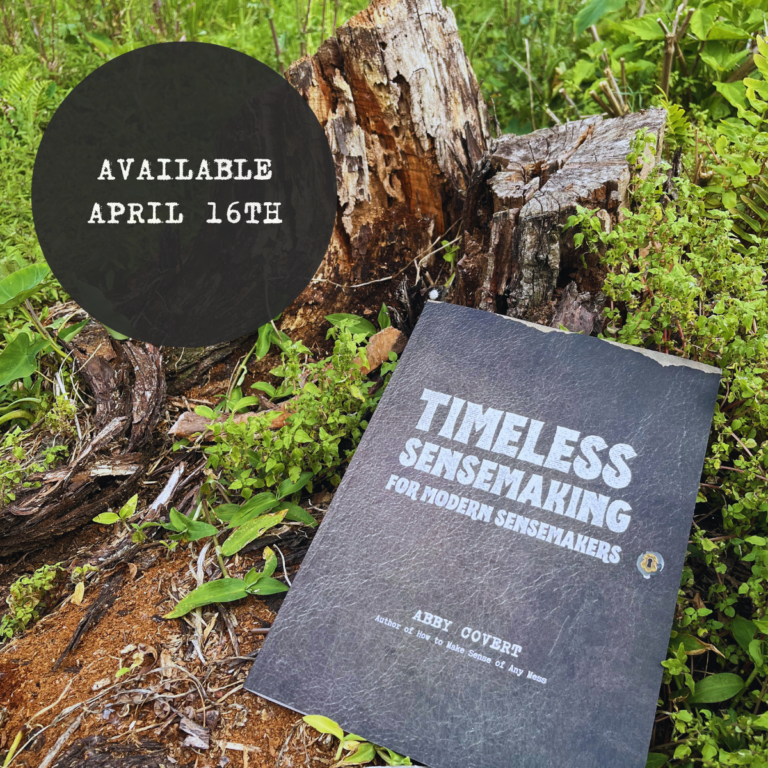
Registration is now open for Abby Covert’s 4th annual Makesensemess, an affordable, online celebration coming up on November 1, 2024.

This is the hottest ticket in the nerdile, infinitely curious information architecture zone. Flexible pricing, anchored around $30.

I have attended several Makesensemesses prior and it’s a great event. If you like messes, or making sense of them, consider joining us.


That is all I have for now. I sit in a campus library looking idly out the window at some gorgeous trees in the arboretum whose leaves seem not more than a week away from turning into their fall colors and changing from there into the next thing. Change is here for each of us, it is all around us, and it is all, ultimately, somehow, good.

Monthly links & notes for July 2024

A hazy sunset, hot as hell, behind the mountains. A peachy sky with scattered clouds is reflected in water.
Photo by Brian Kerr.

4 online readings: Boeing’s weird decades, group dynamics, attempts to define ‘quality’ & Disability Pride Month.

Online reading

Mark Rosenthal’s blog is always great. I recommend his recent post called “Boeing: The Turning Point(s).” He connects Boeing’s ongoing difficulties to two attempts to change company strategy twenty years ago. I enjoyed Mark’s detailed reminiscences from the time:

There were actually two lines running parallel, each one on a two day cycle. … Each time the line was indexed, it generally took a shift to, in succession, pull each plane back, then forward, then dock it into the next position. And because this was a schedule-driven line, the planes moved on time, ready or not. Incomplete work became “travelers”—jobs that traveled with the plane to be completed later when, for example, the parts became available. Exactly who was supposed to do that out-of-sequence work while everyone was busy with the scheduled jobs was a little vague.

The assembly manager for 737 then ran an experiment. Instead of trying to solve all of the problems they could think of before trying anything she took the opposite approach. She got an RV winch, bolted it to the floor by the door, hooked the cable to the last plane, and started pulling it—slowly—through the work position.

If everything was going smoothly, they kept pulling. If something disrupted the work, they stopped the winch, wrote that down, and picked off a few of those things to try to fix on the next cycle.
Boeing: The Turning Point(s)
In early spring of 1999 I was sitting in a classroom at Boeing with a couple of dozen other employees. Everyone with a “management” job code was being sent to this session over a few we…

Daniel Katz writes that, even though we add new people to groups in order to address medium- or long-term needs, there are also short-term benefits:

The act of adding a new person also has immediate benefits to the group, as a new person who doesn’t know the practices and culture of the group can reflect on them as they learn them, ideally leading to lessons and improvements for the whole group.

I think about this often as a consultant—e.g. a person sometimes inserted into groups on a temporary basis, and who sometimes pushes the dirt around when organizations expand, split, or rearrange.

How groups can immediately benefit when new members join
When thinking about a group adding a new person, we often think that while the group will benefit from adding the new person in the long run, there is a cost to the group in the initial period. But…

And Michel Baudin assembled a long, informal survey of different attempts to define “quality” in operations & management contexts. The theme is that people love to talk about quality, but no expert knows, and no group agrees about, what it is:

What is Quality? – Michel Baudin’s Blog
Professionals wrongly assume a shared understanding of quality and talk past each other. Let’s address the issue.

This all becomes a problem in lean interventions—as transmitted by Lean Enterprise Institute, et al—which begin by spinning a group’s tires in an intractable, wasteful effort to produce a working definition of “customer value,” of which “quality” is one component. Of course, none of this is necessary and is best avoided. But the waste and confusion these conversations produce is one reason I walked away from those methods and found better ways to spend the time.

Baudin’s piece brought to mind this entertaining, possibly apocryphal, quote from designer Massimo Vignelli. It bears the confidence of someone who (a) knows quality when they see it, (b) does not care to explain, and (c) will be submitting an invoice:

There are no hierarchies when it comes to quality. Quality is there or is not there, and if is not there we have lost our time.

Disability Pride Month

July is Disability Pride Month, which commemorates the 1990 passage of a key civil rights law in the USA—the Americans with Disabilities Act (ADA).

I wrote on this topic last year:

The world of silence: marking Disability Pride Month
Being a hearing-impaired person whose job is to listen. Quiet, noise, and rest.

Two points I’d add this time around:

  1. The experience of disability has entered my family life in a different, terrifying way in 2024. I am grateful for the limited protections and affordances of the ADA that helped us these past months.
  2. Many of those same protections are now at risk as a result of one of June’s disastrous set of US Supreme Court decisions.

Why discuss any of this at all? Because my disability has mostly been a “hidden” one, and at some point I became tired and ashamed of all the work that went into keeping it so. My disability is an important part of who I am, and—as I wrote in the piece—I have a good life and I do good work.


And that’s it for the moment. Be back next month with more links & notes, and hopefully some other updates in-between.

Monthly links & notes for June 2024

At low tide, exposed bracky sand dries in the sun to the right side of the photo, with a creek on the le
Photo by Brian Kerr.

Multisolving: a newsletter & facilitation method for evaluating new projects. Plus, how to fry a Mars rover.

I’ve been looking for new ways of thinking about problem-solving beyond the tired lean frameworks, and better ways of helping groups decide what to do next. This month, I’ve found something.

Online reading

From Beth Sawin’s June 21st Multisolving Institute newsletter:

People are removing dams so salmon can spawn. They are replacing asphalt with urban gardens, to help cities stay cool and prevent flooding. Highways that divided neighborhoods for decades are being phased out, replaced with parks and walking paths and bikeways. … The systems that surround us—bricks and mortar infrastructure, the structure of healthcare, the endowments of universities—have not always been constructed in ways that respect the interconnection of our world. The tree cover of cities aligns with maps of racial segregation. The wealth of many powerful interests traces back to conquest, slavery, or extraction. Because of this, moving forward is going to sometimes require looking backward and removing structures (and laws, incentives, and habits) that are doing harm. 

I learned from my technical days that multi-objective optimization is hard. Yet it no longer makes sense to suppose that a group can solve one problem at a time—or to ignore the fact that when they do, they’re merely pushing problems around in ways that are unhelpful and unjust.

And “moving forward is going to sometimes require looking backwards and removing structures… that are doing harm.” This reminds me of TRIZ: the laughter that comes with noticing system behaviors that reliably produce bad outcomes. Stopping those and patiently seeing what happens next can be more fruitful than actively starting new things.

Facilitation for engagement with FLOWER

Also from the Multisolving Institute, The Framework for Long-term, Whole-system, Equity-based Reflection (FLOWER), which “helps a group explore the co-benefits a project might produce. … Who would need to be involved? How do we design for co-benefits? How do we ensure burdens and benefits are shared equitably?”

I haven’t had a chance to use FLOWER yet, but have slotted it right next to the strategy-culture bicycle as a method to help a group get real about evaluating projects and their benefits, impacts, and possibilities.

FLOWER - Multisolving Institute
FLOWER: Framework for Long-Term, Whole-System, Equity-Based Reflection FLOWER is an interactive community engagement tool about multisolving. FLOWER helps a group explore the co-benefits a project might produce. It prompts some of the most important questions about multisolving. Who would need to be involved? How do we design for co-benefits? How do we ensure burdens and […]

How to fry a Mars rover

Let’s end on a lighter note. Enjoy Chris Lewicki’s story about a simple wiring mistake on the Spirit Mars rover:

The pulse was sent to the motor. As always, the result was immediate, but this time, alarmingly unfamiliar. The strip chart did not look like anything we had seen before. It did not even look like a broken motor. It was decidedly—something else. … My eyes followed the wires from our breakout box on the test cart to the spacecraft, and the reason for the unfamiliar signal landed like a dagger through my heart. All that power we just released did not go into the RAT-Revolve motor. Due to a mistake I had made with the break-out-box, it went the other direction on the connector interface, sending a surge of electricity straight into the spacecraft, instead of the motor.
My $500M Mars Rover Mistake: A Failure Story — Chris Lewicki
Some mistakes feel worse than death.